Baccarat Odds Explained: Banker, Player and Tie Probabilities (8-Deck)
The three bets, by the numbers
In a standard eight-deck game, the exact probabilities (via combinatorial analysis) are:
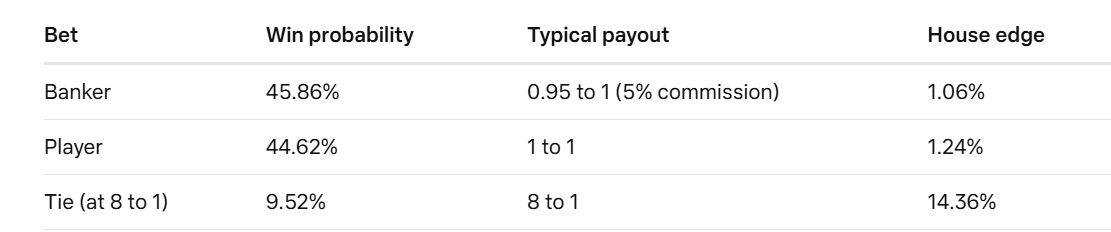
Source: Wizard of Odds — Baccarat Basics and Ask the Wizard — Baccarat.
These are the single most important numbers in baccarat. Memorize them before anything else about the game.
Why Banker wins more often than Player
Banker's 45.86% vs. Player's 44.62% is a gap of about 1.24 percentage points — small, but real. It exists because of the third-card rules: Banker acts after seeing Player's third card (when Player draws), giving it a positional advantage similar to acting last in poker. If you strip out ties and look only at decided hands, Banker wins about 50.68% of the time.
That advantage is exactly why the casino takes a 5% commission on winning Banker bets. Without it, Banker would be a positive-expectation bet — the casino would lose money. The commission pulls Banker's expected return down to −1.06%, which is why Banker is still the cheapest bet on the layout, just not a free one.
The commission, in plain dollars
The 5% commission is often misunderstood. It applies only to winning Banker bets, and only to the winnings — a $100 winning Banker bet returns $195 total ($100 stake + $95 profit), not $200. Over time, that $5 skim per $100 won is precisely what converts Banker's natural 50.68%-of-decided-hands advantage into the casino's 1.06% edge. If a table ever offered Banker with no commission and no compensating rule, the bet would favor the player by about 1.24% — which is why such tables don't exist outside of promotional gimmicks.
What "house edge" actually means
The house edge is your expected loss per unit wagered, averaged over a very large number of hands. It is not a fee taken each hand. Concretely:
Betting $100 on Banker repeatedly costs you about $1.06 per hand on average in the long run.
Betting $100 on Player costs about $1.24 per hand.
Betting $100 on Tie at 8 to 1 costs about $14.36 per hand.
Short sessions can — and often do — look nothing like these averages. Variance dominates the short term. The edge only reveals itself over thousands of hands, which is precisely why it's worth understanding before you size your wagers.
The math checks out cleanly. For the Tie bet at 8 to 1: 0.095156 × 8 − 0.904844 × 1 = −0.1436, i.e. a 14.36% house edge. Same figures, same conclusion.
The Tie bet's deceptive appeal
The Tie bet pays 8 to 1, which feels exciting. But true odds of a tie are roughly 10.5 to 1 (1/0.095156), so the payout falls well short of fair. That gap is the 14.36% edge — roughly thirteen times the Banker bet's edge. Some casinos pay 9 to 1 on ties, which drops the edge to about 4.84%, but that version is rare.
Treat the Tie as what it is: a high-variance lottery ticket, not a core bet.
Does the deck count change things?
Barely. With six decks, the edges are 1.06% (Banker), 1.24% (Player) and 14.44% (Tie at 8 to 1) — essentially identical to eight decks. (We cover this in detail in our post on 6-deck vs 8-deck baccarat.) What changes odds more than deck count: the commission rate, the tie payout, and side-bet pay tables.
Common misconceptions worth retiring
"Player is due after five Bankers." No. Each hand is drawn from a fresh random subset of the shoe; past results don't change the next hand's probabilities (within a single shoe, composition shifts matter only marginally — see our card counting article).
"Tie is a good hedge." Hedging a 1.06%-edge bet with a 14.36%-edge bet doesn't reduce your expected loss; it increases it.
"No-commission baccarat is always better." Not necessarily — variants like EZ Baccarat replace the commission with rules (e.g., Banker wins on a 3-card 7 push) that create nearly the same total edge, around 1.02–1.46%.
The honest takeaway
Baccarat's main bets are among the fairest in the casino, but "fairest" still means negative expectation. No pattern-tracking or betting system changes 45.86 / 44.62 / 9.52. What the math can do is tell you exactly what each decision costs, so you can make informed choices instead of guessing.
If you'd like to see these probabilities computed live against the actual cards remaining in a shoe — win rates, expected value, and position sizing included — try Baccarator, available on the App Store. Stop guessing, start calculating.
