Baccarat House Edge Explained: Why Banker Costs Only 1.06%
Imagine flipping a coin with a friend 10,000 times, $100 a flip. Fair coin, fair payouts — you'd expect to walk away even.
Now your friend adds one small rule: when you win, he pays you $95. When you lose, you pay the full $100. Same coin. Same luck. Nothing else changes.
Run the numbers: you win roughly 5,000 flips and pocket $475,000. You lose roughly 5,000 flips and hand over $500,000. Down $25,000 — without making a single bad call. That missing $2.50 per $100 is the house edge: a quiet little tax baked into the payouts themselves. Nobody pickpockets you at the table. The math just leans, slightly and permanently, toward the house.
Baccarat's banker bet has one of the gentlest leans in the whole casino — about $1.06 out of every $100 you wager. This article shows exactly where that number comes from, why the 5% commission exists, and why "gentle" still isn't free.
What house edge really means
Think of it as the casino's cut — the slice of every bet the house expects to keep if you played forever. It's not a fee anyone collects, and no dealer slides it off the table. It's hiding inside the payouts: you get paid slightly less than the true odds deserve.
Another way to see it: it's the price of admission. Every $100 you push onto a banker bet buys you the evening's thrill at a long-run cost of about $1.06 — cheaper than a movie ticket, as long as your bets stay small and your night stays short. The trouble starts when the bets get big and the night gets long, because that tiny cut gets taken on every single hand.
One thing it is not: a prediction about tonight. House edge is a long-run average — what happens over millions of hands. On any given evening, plain old luck (wins and losses bouncing up and down) drowns it out completely. You can absolutely walk away a winner with a 1.06% edge against you. You just can't expect to, night after night, forever.
Banker 1.06% vs Player 1.24% vs Tie 14.36%
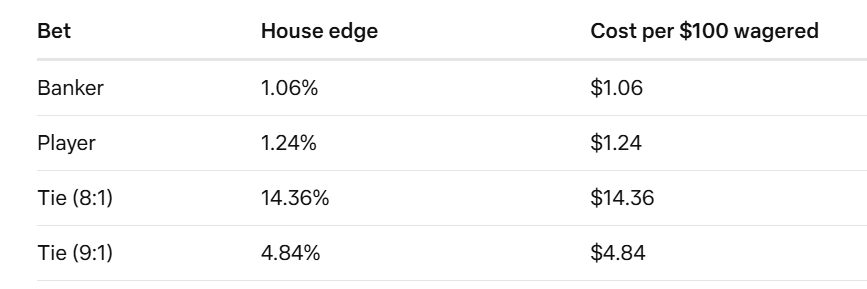
Here are the edges for the three main bets under standard eight-deck rules with 5% banker commission (Wizard of Odds):
Worked example: where the 1.06% comes from
Using the exact eight-deck probabilities (banker wins 45.8597%, player wins 44.6247%, tie 9.5156% — ties push):
Banker win pays 0.95 (even money minus 5% commission): 0.458597 × 0.95 = +0.435667
Player win loses the stake: 0.446247 × 1 = −0.446247
Tie: stake returned: 0.095156 × 0 = 0
EV = 0.435667 − 0.446247 = −0.010579, or −1.06% per unit wagered
That's it. That's the whole 1.06%. Three probabilities, one commission, one subtraction.
For comparison, the Player bet: 0.446247 × 1 − 0.458597 × 1 = −0.012350, or −1.24%. And the Tie at 8:1: 0.095156 × 8 − 0.904844 × 1 = 0.761248 − 0.904844 = −0.143596, or −14.36% — more than thirteen times the cost of a banker bet.
The 5% commission, demystified
The commission confuses everyone, because it feels like a penalty for picking the best bet. It's the opposite: it's the reason the best bet stays best.
Remember, the banker hand wins 50.68% of decided hands. Without any commission, the math flips: at full even money, the banker bet would have a player edge of about 1.24% — the casino would lose money on every banker bettor (Wizard of Odds). The 5% commission shaves exactly enough off banker wins to turn that player advantage into a 1.06% house edge.
How sensitive is it? The Wizard's reduced-commission table shows the banker edge at various commission levels (eight decks):
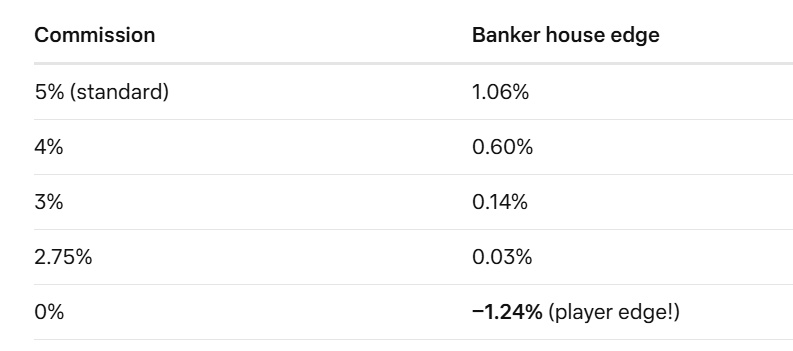
Two lessons. First, if you ever find a reduced-commission table, the math gets dramatically better — at 2.75% commission the game is nearly break-even. Second, "no commission" baccarat isn't free: those tables compensate elsewhere (usually by paying only half on banker wins with a total of 6). Always read the felt.
How baccarat compares to blackjack, roulette and slots
A 1.06% edge sounds abstract until you line it up against the neighbors (typical figures, via Wizard of Odds and standard references):
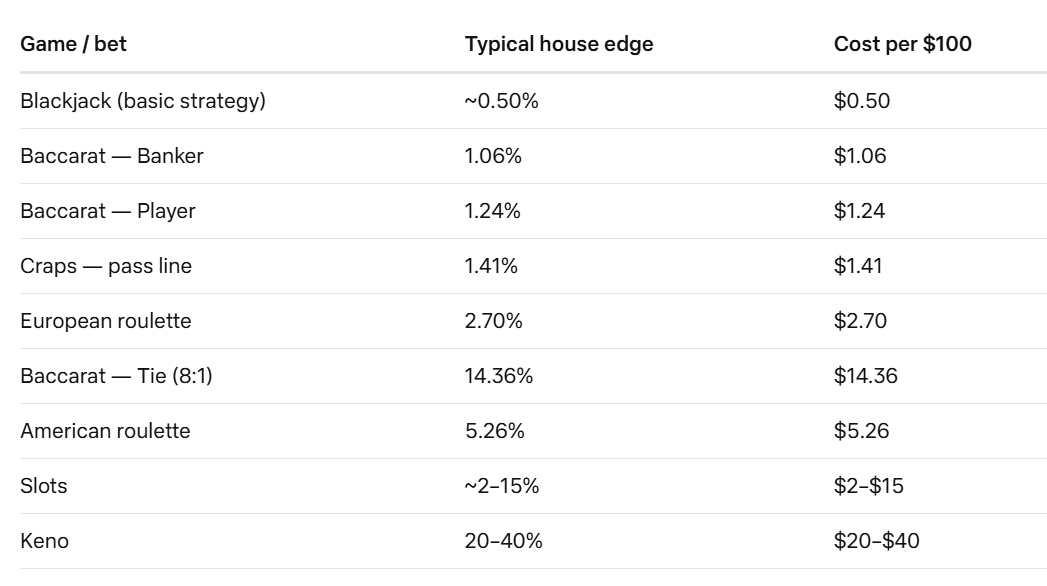
Two things pop out. First, baccarat's main bets sit in genuinely elite company — only blackjack with perfect basic strategy is cheaper among table games. Second, the Tie bet at 8:1 costs more than triple American roulette. The payout looks generous; the price tag isn't.
Why a low edge still grinds you down
Here's the part the casino is counting on you to skip: a small edge, repeated relentlessly, is a grinding wheel.
Do the session math. Say you bet $100 a hand on banker, 80 hands an hour — a brisk but normal mini-baccarat pace. That's $8,000 of action per hour. At 1.06%, your theoretical hourly cost is about $85. Play five hours, and the expected cost is over $400 — from an edge that sounded like pocket change.
This is the law of large numbers at work: the more hands you play, the closer your actual results converge to the expected value. Variance gives you winning sessions; the edge makes sure that, across enough sessions, the casino's share materializes. Think of it like a leaky bucket: one drip is nothing, but leave it overnight and the floor is wet.
The honest conclusion isn't "never play" — it's "know the price." A 1.06% edge is one of the fairest prices a casino offers. Just don't mistake a fair price for no price. Session length and bet size are the two dials that control your real cost, and they're both in your hands.
House edge vs RTP: two names, one number
You'll often see the same idea expressed as RTP — "return to player." It's just the flip side: RTP = 100% − house edge. A banker bet with 1.06% edge has 98.94% RTP — meaning $98.94 of every $100 is theoretically returned. Casinos advertise RTP because "98.94% back!" sounds friendlier than "we keep 1.06%." Same number, better lighting.
One more distinction worth knowing: theoretical edge vs actual hold. The house edge is the math; the "hold" is what the casino actually keeps from real players, and it's always higher — because real players make side bets, chase losses, and play tired. The edge assumes perfect discipline. The hold measures human nature.
Worked example: the theoretical cost of an evening
Let's price a realistic session. You bet $25 a hand on banker, 80 hands an hour, for 4 hours:
Total wagered: $25 × 80 × 4 = $8,000
Theoretical cost: $8,000 × 1.06% = $84.80
Eighty-five dollars for four hours of entertainment — cheaper than a decent dinner out. Now run the same session on the tie bet at $25 a hand: $8,000 × 14.36% = $1,148.80 in theoretical cost. Same table, same hours, thirteen times the price. That's what the edge column in the table above is really telling you: not whether you'll win tonight, but what the evening costs on average.
FAQ
1. Is a lower house edge always better?
For expected cost, yes — but check the pace. A 1.06% game dealt at 120 hands an hour can cost more per hour than a 2% game dealt at 40 hands an hour. Edge × hands × bet size is the real formula.
2. Does the 5% commission apply to every banker win?
In most casinos it's tracked with small markers and collected at the end of the shoe, not hand by hand — but economically it's identical. (Watch out for tables with a minimum commission, e.g. $1: on a $10 bet that's effectively 10%, which changes the math badly.)
3. Can the house edge ever be zero or negative?
On the banker bet, only with reduced commission: at 0% commission the player would have a ~1.24% edge, which is why true zero-commission tables always change another rule to compensate. There's no free lunch on the felt — only differently-priced ones.
The banker bet's 1.06% is the cheapest seat at the table — but "cheap" is still a cost, and every bet on the felt has a price tag. Want to see the exact expected cost of each bet, computed live from the cards in front of you?
Download Baccarator on the App Store and check the EV panel before every wager. Stop guessing, start calculating.
