We Simulated 1 Million Baccarat Shoes: Here's What Happened
Our baccarat simulation dealt 1 million 8-deck shoes, about 80 million hands. A typical shoe had 80 hands, 7 or 8 ties, and a longest streak of 6. Betting 1 unit on Banker every hand lost 0.84 units per shoe on average, yet 47.6% of individual shoes still finished in profit.
That last pair of numbers is the whole story of baccarat in one line. Short runs look good surprisingly often. Long runs don't.
How many hands are in a baccarat shoe? Baccarat simulation results
Every shoe in our baccarat simulation used 8 decks, the standard drawing rules, a burn at the start, and a cut card 16 cards from the end. The last hand is dealt once the cut card appears.
| Share of shoes | |
|---|---|
| 77 hands or fewer | 6.60% |
| 78 hands | 13.00% |
| 79 hands | 21.60% |
| 80 hands | 24.40% |
| 81 hands | 19.00% |
| 82 hands | 10.30% |
| 83 hands or more | 5.10% |
The average was 79.9 hands. The range is tight because each hand uses between 4 and 6 cards, and the cut card position barely changes. If your casino places the cut card earlier, a shoe will have fewer hands, roughly one less hand for every 5 cards.
A full 8-deck baccarat shoe is about 80 hands. That number almost never changes much.
How many ties per baccarat shoe
A Tie happens on 9.52% of hands, so a shoe averages 7.6 ties. The most common count was 7, and three out of four shoes had between 5 and 10. Fewer than 1 in 1,000 shoes had no tie at all.
That frequency is why the Tie bet feels "due" so often and why it still costs 14.36% at 8 to 1. You see ties constantly; you just aren't paid enough for them. Our baccarat tie bet odds post has the full math.
How long is the longest streak in a shoe
Ignoring ties, the most common longest streak in a shoe was 6 hands in a row (26.4% of shoes). 68.9% of shoes had a streak of 6 or more somewhere, 23.4% reached 8, and 6.1% reached 10.
Seeing a 7 or 8 in a row isn't a sign of anything. It is what an ordinary shoe looks like.
We also checked whether streaks predict the next hand. They don't; the details are in baccarat patterns.
Betting Banker every hand: one shoe at a time
Banker won more hands than Player in 52.4% of shoes and fewer in 43.0%; the rest were even. That's the 45.86% vs 44.62% edge showing up shoe by shoe.
Now add the 5% commission. Betting 1 unit on Banker for every hand of a shoe:
| Result | |
|---|---|
| Average result per shoe | −0.84 units |
| Typical swing per shoe (1 standard deviation) | ±8.3 units |
| Shoes that ended in profit | 47.60% |
The average loss is tiny compared with the swing. That is why one shoe tells you almost nothing about whether a bet is good.
Why 47.6% of shoes win but the long run loses
Now play the same flat Banker bet over more and more shoes and count how often you are still ahead.
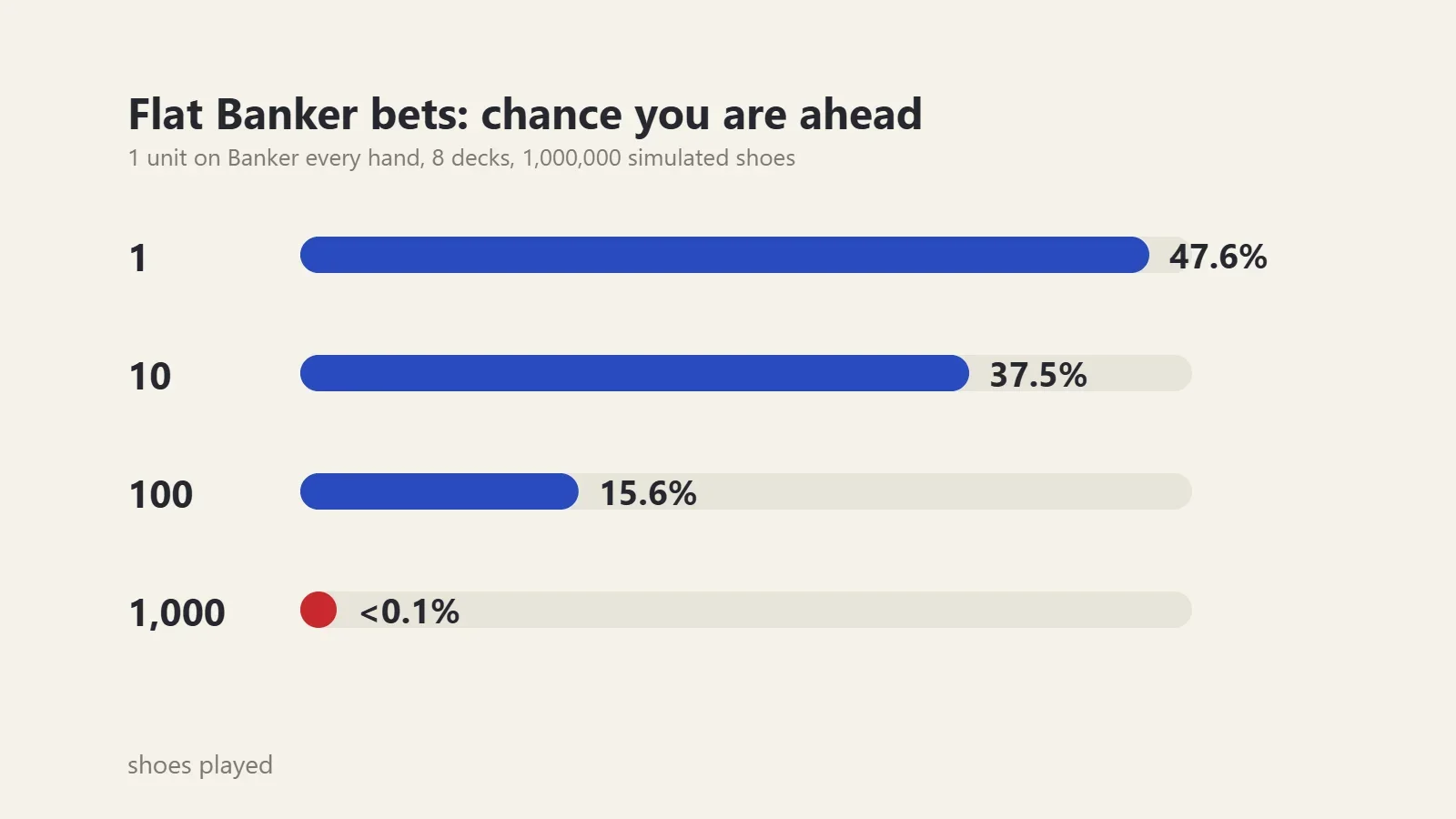
After 1 shoe, 47.6% of players are ahead. After 10 shoes, 37.5%. After 100 shoes, 15.6%. After 1,000 shoes, fewer than 1 in 1,000.
The swing grows with the square root of the number of hands, while the house edge grows in a straight line. Early on the swing hides the edge. Given enough hands, the edge always wins the race.
Short-term luck is real. The house edge is just patient.
This is also why no betting system fixes it. Changing how much you bet changes the size of the swings, not the direction of the average. We tested the common ones in baccarat betting systems.
At the start of a fresh shoe, every bet has a negative expected value. Only the cards left in the shoe can change that, and only briefly.
Run the numbers on your own shoe
A simulation shows the average shoe. Baccarator shows the one in front of you. After each hand you enter the cards and tap Calculate, and it recalculates the odds and expected value for Banker, Player, Tie, pairs and side bets from the cards that are left. If a bet briefly turns positive, it shows a Kelly sizing suggestion; that only appears when expected value is positive, it is a long-run average, and the next hand can still lose. Positive moments are rare and short. You can practice with virtual chips, with no real money involved.
Baccarat simulation FAQ
How many hands are in a baccarat shoe?
About 80 with 8 decks and a cut card 16 cards from the end. In our baccarat simulation of 1 million shoes, 80 hands was the most common count and 97% of shoes had between 77 and 83.
How many ties are in a baccarat shoe?
About 7.6 on average. The most common count is 7, and about three in four shoes have between 5 and 10 ties.
Is baccarat profitable in the long run?
No. Flat Banker betting lost 0.84 units per shoe on average. Almost half of single shoes ended ahead, but after 1,000 shoes fewer than 1 in 1,000 players were still in profit.
Baccarator is a math tool for education. No real-money gambling. 21+ only.
