How the Remaining Cards Change Baccarat Odds: A 20-Card Thought Experiment
In my last post I used an extreme example. The shoe has 20 cards left, and every one of them is a 10 or a face card. The next hand can only be a Tie.
You might be thinking what I was thinking. Real shoes never look like that.
Fair. So this time let's use cards that could actually show up, and see what happens.
Cards don't remember, but they do get used up
A coin has no memory. Flip heads ten times, and the next flip is still 50/50, because the coin is the same coin.
A shoe is different in one small but important way. Every card that gets dealt is gone. It won't come back until the next shoe. So the shoe after 100 cards is a slightly different shoe from the one you started with.
The road records what happened. The cards record what's left. Only the second one touches the next hand.
That's the whole idea. The rest of this post is about how big the effect is.
Same 20 cards, two very different games
Here's the setup. Take 20 small cards, five each of Ace, 2, 3 and 4.
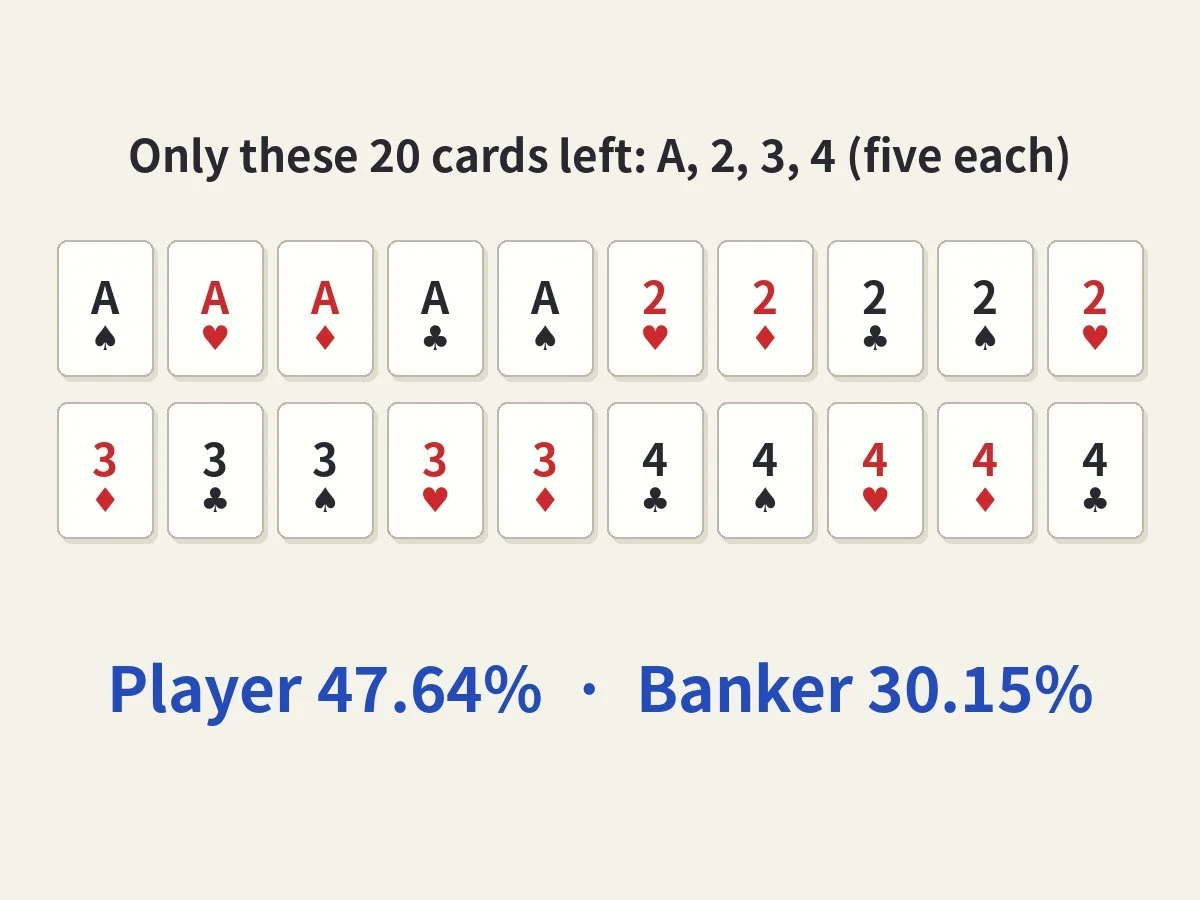
If these are the only 20 cards left in the shoe, the numbers get strange: Player wins 47.64% of the time, and Banker only 30.15%. Banker, the bet that's usually a little better, is now way behind.
I ran a few other 20-card shoes too. All numbers below are calculated exactly, card by card, using standard drawing rules.
| Banker | Player | Tie | |
|---|---|---|---|
| Full 8-deck shoe (416 cards) | 45.86% | 44.62% | 9.52% |
| 20 left, all worth 0 (10, J, Q, K) | 0.00% | 0.00% | 100.00% |
| 20 left, five each of A, 2, 3, 4 | 30.15% | 47.64% | 22.21% |
| 20 left, ten 8s and ten 9s | 31.73% | 31.73% | 36.53% |
| 20 left, mix similar to a full shoe | 45.93% | 44.46% | 9.61% |
Look at the last row. Twenty cards with roughly the same mix as a full shoe give you almost the same numbers as a full shoe. It's not how many cards are left that matters. It's which ones.
So why does it feel like nothing changes?
Now take those exact same 20 small cards and remove them from a fresh 8-deck shoe instead. 396 cards are left.
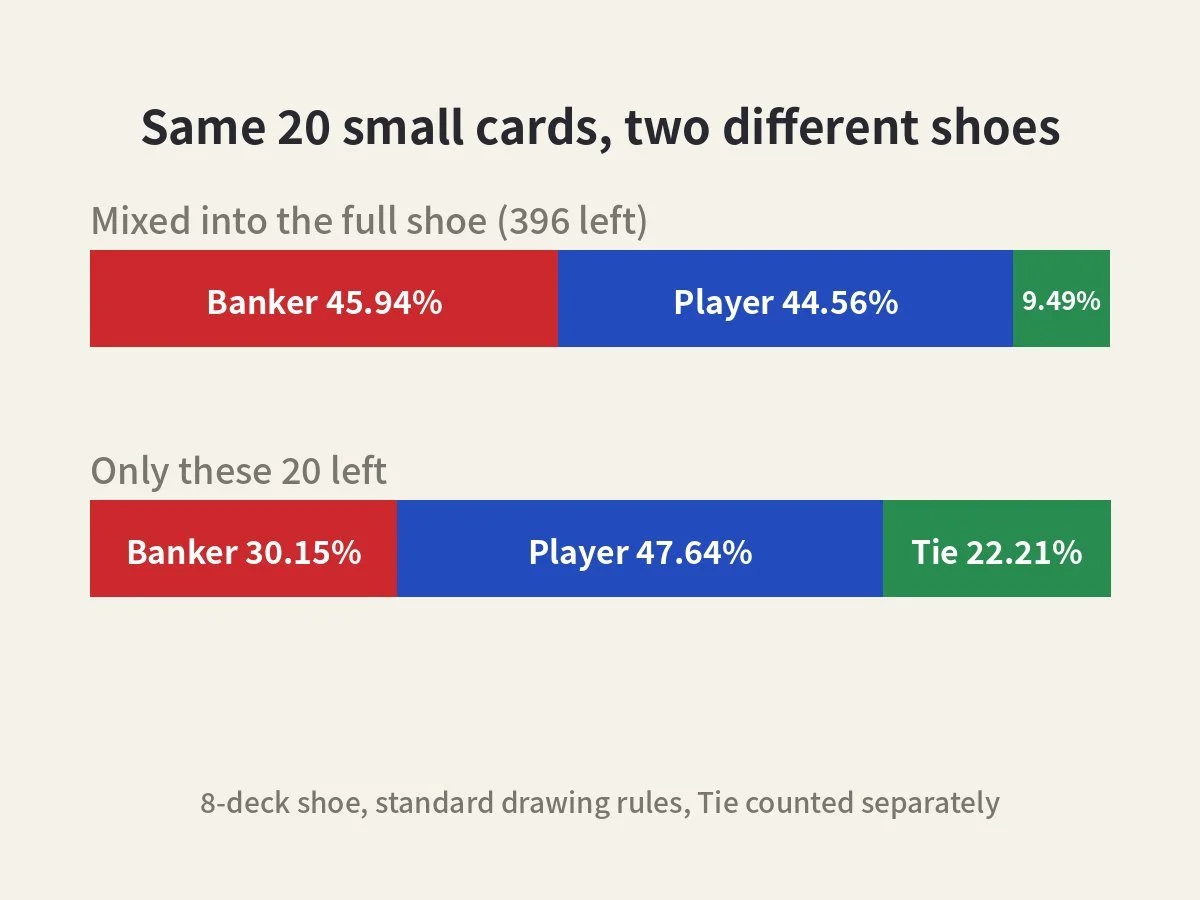
Banker goes from 45.86% to 45.94%. That's it. Here's what happens when you pull out different kinds of 20-card groups from a full shoe.
| Banker | Player | Tie | |
|---|---|---|---|
| Nothing removed | 45.86% | 44.62% | 9.52% |
| Remove 20 zero-value cards | 45.81% | 44.55% | 9.64% |
| Remove five each of A, 2, 3, 4 | 45.94% | 44.56% | 9.49% |
| Remove ten 8s and ten 9s | 45.73% | 44.58% | 9.69% |
| Remove 20 cards from 5, 6, 7 | 45.85% | 44.82% | 9.32% |
Every change is less than a quarter of a percentage point.
I studied biochem before I started writing iOS apps, and this is the same thing as concentration. A spoonful of salt in a cup of water is a big deal. The same spoonful in a swimming pool, you won't taste it.
Early in the shoe, each card is a spoonful in a pool. Near the end, it's a spoonful in a cup.
What this does and doesn't mean
It means the real information in baccarat lives in the remaining cards, not in the pattern on a scorecard. If you want the longer story on what scorecards actually do, I wrote about it here.
It doesn't mean you can see the future. Even when the numbers shift, they're still probabilities, and the next hand can go either way. In most real shoes, most of the time, the shift is small, like the second table shows. Expected value is a long-run average, not a promise about any single hand.
That's the part I wanted to see for myself, which is why my app Baccarator does this math. You enter the cards that were dealt, and it recalculates what's left. It doesn't tell you what comes next. It just shows you where the numbers are right now.
If you want to see how the full-shoe numbers change between 6 and 8 decks, there's a table for that too.
Run your own 20-card experiment
Baccarator is free on the App Store. Enter a few hands, card by card, and watch how far the remaining cards push the Banker, Player and Tie numbers. It recalculates after every card, and you can practice with virtual points, so no real money is involved.
Try the small-card shoe from this post and see if you get 47.64% too.
Download Baccarator free|https://apps.apple.com/app/id6740475592
FAQ
1. Do the remaining cards really change baccarat odds?
Yes. Cards are dealt without replacement, so every card that leaves the shoe changes what's left. With a full shoe the change per card is tiny. With only a few dozen cards left, it can be much larger.
2. Is tracking dealt cards the same as reading the road?
No. The road records which side won. Tracking cards records which card values are gone. Only the second one changes the math for the next hand.
3. If the probabilities shift, does that mean I'll win?
A: No. A shifted probability is still a probability. Expected value describes a long-run average, and any single hand can still lose.
Baccarator is a math tool for education. No real-money gambling. 21+ only.
