Tie Bet Odds: Why 8:1 Pays But the House Edge Is 14.36%
Walk past any baccarat table and you'll hear it: the little gasp when a tie lands, and one lucky player scooping up eight times their money. The tie bet is the table's lottery ticket — the one wager that can turn a boring hand into a bar story.
It's also the worst deal in the building, and the whole tragedy fits in one sentence: the casino pays you 8-to-1 on something that happens about 1 time in 10.5. A fair payout would be around 9.5-to-1. That shortfall is the entire 14.36% house edge — about $14.36 out of every $100 you bet on ties, roughly thirteen times the cost of betting banker.
This article puts the tie bet under a microscope: the exact math, why a single unit of payout changes everything, why your brain falls for it anyway, and the one narrow scenario — deep in the shoe, cards counted — where it stops being a donation.
The math: 9.52% probability × 8:1 payout = −14.36% EV
The tie bet is beautifully simple: you're betting the player and banker hands finish with equal totals. Win, and you're paid 8 to 1 at most tables. Lose on any non-tie — which is everything else.
Ties occur 9.5156% of the time in an eight-deck game (Wizard of Odds). That's roughly one hand in ten and a half — often enough to keep hope alive, rare enough to be expensive. The full arithmetic:
Tie hits: 0.095156 × 8 = +0.761248
Anything else (90.4844%): 0.904844 × 1 = −0.904844
EV = 0.761248 − 0.904844 = −0.143596, or −14.36% per unit wagered
Translation: every $100 you put on ties costs you about $14.36 in the long run. Compare that to the banker bet's $1.06 per $100. The tie isn't slightly worse — it's roughly thirteen and a half times worse.
Here's the intuition your gut misses: "fair" odds for a 9.5156% event would be about 9.5 to 1. The casino pays 8. That missing 1.5 units of payout, spread across every wager, is the entire 14.36%. The payout looks generous because 8:1 is a big number; it's ungenerous because the event is rarer than the payout implies.
8:1 vs 9:1 paytables
Now watch what a single unit of payout does. A few tables — historically places like Binion's Horseshoe in Las Vegas — pay 9:1 on ties instead of 8:1. Same probability, one extra unit of winnings:
9:1 EV: 0.095156 × 9 − 0.904844 × 1 = 0.856404 − 0.904844 = −0.048440, or −4.84%
One unit of payout wipes out 9.5 percentage points of house edge. That's the leverage of low-probability bets: tiny paytable changes cause enormous edge swings. The full picture across deck counts (Wizard of Odds):
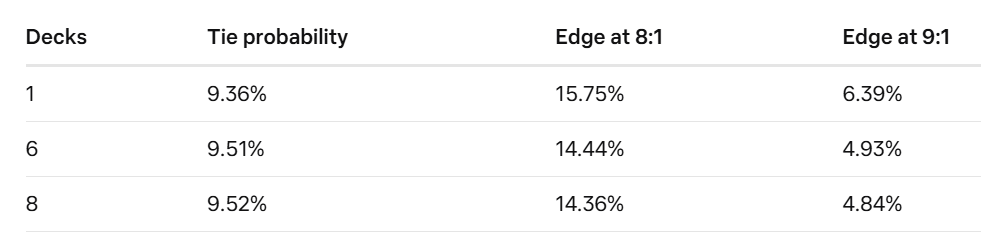
Even at 9:1, the tie costs $4.84 per $100 — still nearly four times the player bet. The 9:1 table is a kinder trap, not an escape. But the table makes the broader point: on the tie, always check the paytable before you check your feelings, because one digit on the felt layout moves the price more than any strategy ever could.
Why the tie bet still tempts everyone
If the math is this brutal, why is there always money on the tie spot? Three reasons, all human:
1. The payout is vivid; the probability is abstract. "8 to 1!" is a story — eight crisp chips sliding toward you. "9.52%" is homework. Behavioral researchers call this probability neglect: our brains overweight rare, exciting outcomes and underweight their rarity. The casino prices the bet on the math; you evaluate it on the movie in your head.
2. Ties feel "due." After a long run with no ties, the felt practically whispers that one is coming. It isn't — each hand is dealt from the remaining shoe, and the base rate barely budges. Roughly one hand in 10.5 ties on average, which means droughts of 20+ tie-less hands are utterly normal. Randomness has no memory and no sense of fairness.
3. Small stakes, big dreams. Tie bets are usually small — a $5 chip hoping to become $40. The absolute dollars at risk feel trivial, so the 14.36% rate never gets scrutinized the way it would on a $500 banker bet. But rates don't care about denominations: 14.36% of $5, repeated, is the same bad price as 14.36% of $500.
None of this makes tie bettors foolish — it makes them human, and the bet is priced for exactly that humanity.
When (if ever) does the tie become playable?
Here's the honest exception, and it's a narrow one: card counting, deep in the shoe. Ties get more likely when the remaining shoe is rich in even-valued cards. Why? Because even ± even = even, and when the shoe runs out of odd cards, hand totals cluster on even numbers — and matching even totals means ties. Analyst John May built a system around exactly this: count +1 for every odd card dealt, and when the count hits 160 in an eight-deck shoe, the remaining shoe is even-heavy enough that tie probability roughly doubles (bettingwebsites.org.uk).
Analyst Eliot Jacobson later confirmed the effect and quantified it: against a 9:1 tie paytable, a specialized count can find a genuine edge on about 2.27% of hands — but at the standard 8:1 payout, he concluded there's effectively no practical way to beat it, since the cut card (typically ~14 cards from the end) kills most deep-shoe opportunities (casinocitytimes.com).
Read that again: even with perfect counting, the 8:1 tie is essentially unbeatable, and the 9:1 tie is beatable on barely two hands out of a hundred — if you can find a 9:1 table, which are vanishingly rare. The tie bet's reputation as "the sucker bet" survives contact with the most sophisticated analysis available.
The full mechanics of May's odd-card system deserve their own treatment — we break it down step by step in our article on John May's tie-count system.
Paytable hunting: the 9:1 tables (and the 9.4:1 unicorn)
Because one unit of payout moves the edge by 9.5 points, the tie bet is the rare wager where shopping for paytables is a genuine strategy. The known sightings:
9:1 — paid historically at Binion's Horseshoe in Las Vegas and some online casinos. Edge drops to 4.84% (8 decks). Still worse than banker/player, but no longer a mugging.
9.4:1 — the old 5Dimes "bonus casino" reportedly paid this, cutting the eight-deck edge to about 0.79% (Wizard of Odds). At that price the tie becomes one of the cheapest bets in the casino — which is presumably why the paytable didn't survive.
The lesson generalizes: on low-probability bets, the paytable matters more than anything you do. A tie bettor's single most profitable move isn't a system or a count — it's finding a table that pays 9:1 instead of 8:1. Casinos know this, which is why 9:1 tables are rare and 9.4:1 tables are extinct.
FAQ
1. How often does a tie actually happen?
About 9.52% of hands on an eight-deck game — roughly one in 10.5. But "roughly" does heavy lifting: tie droughts of 20–30 hands are normal, and so are back-to-back ties. The base rate is a long-run average, not a schedule.
2. Do ties push my banker/player bet, or do I lose?
Push — your stake is returned untouched. This is standard everywhere. (It's also why "banker wins 50.68% of decided hands" is a meaningful stat: ties are simply removed from the equation.)
3. Is the tie bet ever the right play?
At 8:1, no — not by the math. At 9:1, it's a defensible entertainment bet at $4.84 per $100. With a deep-shoe count on a 9:1 table, it's the only scenario where the tie has ever been genuinely beaten — and even then, on barely 2% of hands. For everyone else: admire the 8:1 payout, and keep your chips on banker.
The tie bet isn't evil. It's entertainment with a 14.36% cover charge — the steepest on the felt. If you play it, play it knowing the price. And if you want to watch that price move in real time as the shoe depletes, that's exactly what Baccarator's side-bet EV panel does.
Monitor every side bet's live expected value with Baccarator — free on the App Store. Stop guessing, start calculating.
