What Is Expected Value (EV) — and How to Use It for Baccarat Side Bets
EV in one formula
Expected value is simply the probability-weighted average of all outcomes:
EV = (probability of win × amount won) − (probability of loss × amount lost)
If EV is negative, the bet costs you money in the long run. If it's positive, it earns money. In a casino, almost everything is negative — the interesting question is how negative, because that tells you the true price of each bet.
Worked example: the Tie bet
From combinatorial analysis of an eight-deck game, ties occur 9.5156% of the time (Wizard of Odds). At the standard 8-to-1 payout:
Win: 0.095156 × 8 = +0.7612
Lose: 0.904844 × 1 = −0.9048
EV = −0.1436, or −14.36% per unit wagered
Every $100 wagered on Tie costs about $14.36 on average. Now compare that to the main bets, which use the same math:
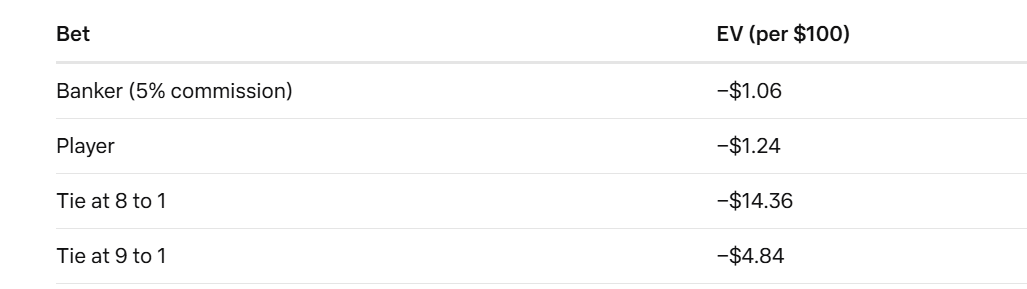
A single formula turns marketing ("8 to 1!") into economics ("costs $14.36 per $100").
Applying EV to side bets
Side bets are where EV earns its keep, because their payouts look generous while their hit rates are tiny. Using published combinatorial analyses (Wizard of Odds — Baccarat Side Bets):
Dragon 7 (Banker wins with a 3-card 7, pays 40 to 1): hits 2.2534% of hands. EV = 0.022534 × 40 − 0.977466 × 1 = −7.61%.
Panda 8 (Player wins with a 3-card 8, pays 25 to 1): hits 3.4543% of hands. EV = 0.034543 × 25 − 0.965457 × 1 = −10.19%.
Player/Banker Pair (first two cards match, pays 11 to 1): hits 7.47% of hands. EV ≈ −10.36% (Wizard of Odds — Baccarat Basics).
Notice the pattern: the more exciting the payout, the worse the price tends to be. Side bets typically cost 5–10× more per dollar wagered than the main bets. That's not an accident — it's how casinos monetize the entertainment value of a long-shot payout.
Why a 40-to-1 payout can still be a bad bet
Humans are wired to overweight rare, vivid outcomes — a cognitive bias psychologists call probability neglect. A 40-to-1 payout feels like it should be valuable. But "fair" odds for an event with probability 2.2534% would be about 43.4 to 1. The casino pays 40. That shortfall of 3.4 units, spread across every wager, is the 7.61% edge. EV doesn't care how exciting a payout feels; it only cares about the arithmetic.
EV vs. variance: the two numbers that matter
EV tells you the long-run cost. Variance tells you how bumpy the ride is. The Tie bet has far higher variance than Banker — most hands lose, occasionally one pays big. Two bets can have the same EV with wildly different experiences, and a high-variance negative-EV bet is the fastest way to drain a session bankroll.
This is why serious analysis looks at both: EV for the price, variance (or standard deviation) for the risk. A bet that's "only" −2% but extremely volatile can still be dangerous with aggressive sizing.
Can EV ever be positive in baccarat?
In theory, yes — but only at the margins. As cards are dealt from a shoe, the remaining composition shifts slightly, and some analyses show that certain side bets can briefly become positive-EV deep in a shoe with the right cards removed. Researchers have documented this for bets like Dragon 7 and Panda 8 (Wizard of Odds — Card Counting the Panda 8 Bet). In practice, the edges are small, the opportunities rare, and exploiting them requires near-perfect tracking — more on that in our card counting article.
For the main bets, the answer is effectively no: the edges from composition shifts are far too small to overcome the 1.06–1.24% baseline.
Using EV in practice
You don't need to compute EV at the table. The practical workflow is:
Learn the EVs once — the table above covers 95% of decisions.
Treat EV as a price tag. A −10% side bet isn't "bad luck when it loses"; it's a $10 average cost per $100 wagered, paid willingly for entertainment.
Never chase. A negative-EV bet doesn't become positive because you're down. Each hand is priced independently.
Size wagers to your bankroll, not to the payout. (See our article on the Kelly criterion.)
EV won't tell you which hand will win. Nothing can — baccarat outcomes are random, and anyone claiming otherwise is selling something. What EV gives you is honesty: the exact long-run price of every choice on the felt.
Want to see live EV numbers for the actual cards left in a shoe, instead of textbook averages? Baccarator computes real-time win probabilities and expected value from the remaining deck composition — on the App Store. Stop guessing, start calculating.
