There is no single formula for baccarat odds. To calculate them, you list every way the cards can come out of an 8-deck shoe, play each one through the fixed drawing rules, and add up how often Banker, Player or Tie wins. Done exactly, that gives Banker 45.86%, Player 44.62% and Tie 9.52%.
The method is simpler than it sounds. It is mostly counting, and you can check the first step with a pen.
Why baccarat probability has no simple formula
In roulette one number decides everything, so one fraction gives you the odds. Baccarat has up to six cards per hand, and whether the fifth and sixth cards are dealt depends on the first four. Banker's decision even depends on which card Player drew.
That branching is why nobody writes baccarat odds as one neat equation. You count instead.
Baccarat odds get counted, card order by card order, with no shortcut formula.
Start with two cards: the odds of each total
An 8-deck shoe has 416 cards. Tens and face cards count as 0, so 128 cards are worth 0 and each value from 1 to 9 has 32 cards.
Here is a calculation you can check by hand. A two-card 9 can come from 0+9, 9+0, 1+8, 8+1, 2+7, 7+2, 3+6, 6+3, 4+5 or 5+4. Two of those use a 0 card, worth 128 × 32 orders each, and eight use two non-zero cards, worth 32 × 32 each. Divide by 416 × 415 and you get 9.49%.
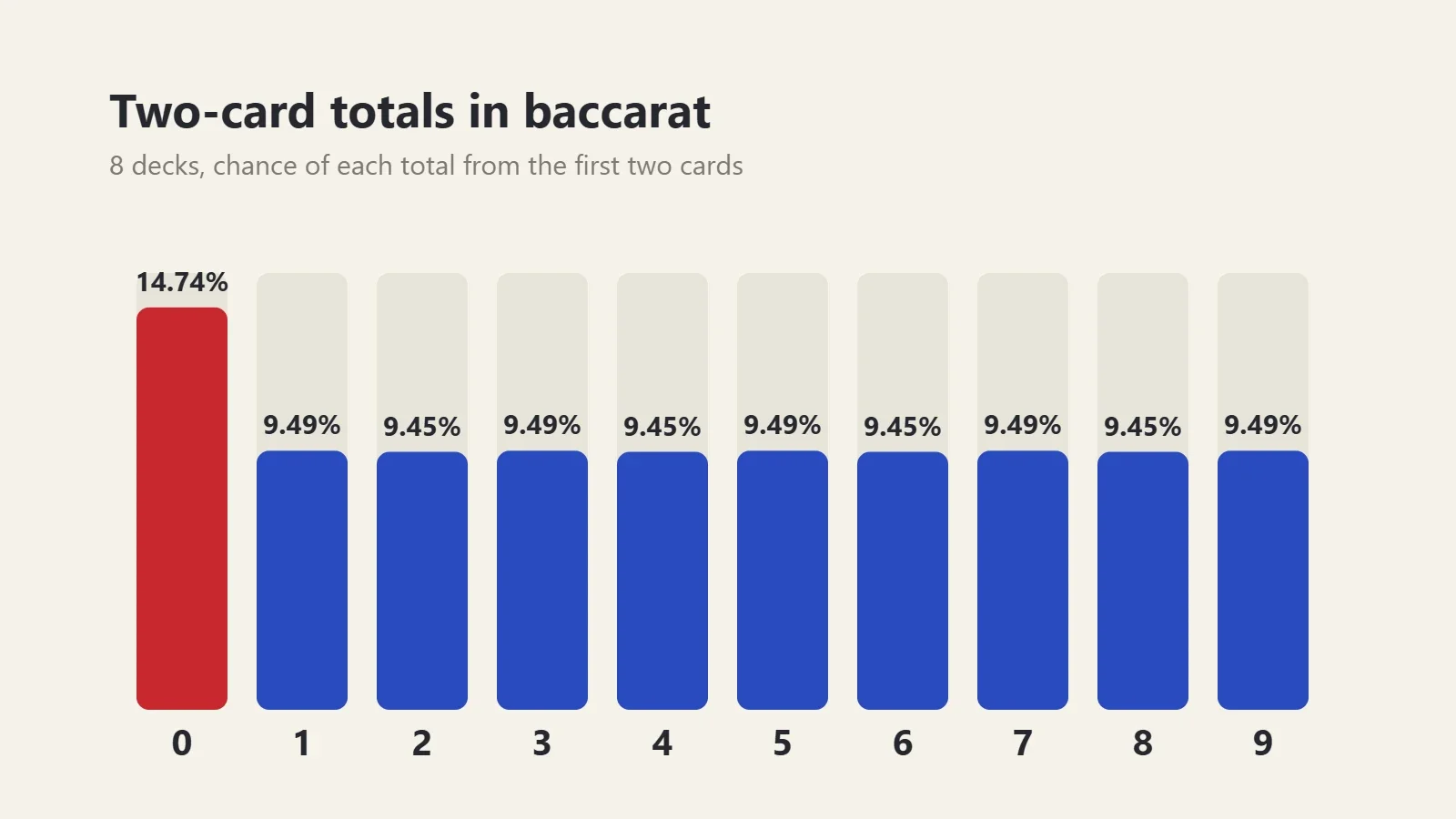
Total 0 stands out at 14.74% because there are so many 0-value cards. Every other total sits close to 9.5%. A natural, an 8 or 9 with two cards, happens for a given side about 18.94% of the time.
Adding the third-card rules to the calculation
Now the branching starts. If either side has a natural, the hand stops. If not, Player draws on 0 to 5. Then Banker draws or stands according to its total and Player's third card, as laid out in the baccarat third card rules.
So for every combination of the first four cards, you follow the rules to see whether a fifth card comes, then a sixth, and you weight each path by how many cards of that value are still in the shoe. Each card you deal changes the next fraction a little: after one 0-value card is out, the next one is 127 out of 415, not 128 out of 416.
That works out to about a million weighted paths. A computer finishes them in seconds.
| Probability | |
|---|---|
| Banker wins | 45.86% |
| Player wins | 44.62% |
| Tie | 9.52% |
| One side has a two-card natural (8 or 9) | 18.94% |
The Tie number is the one people underestimate. Close to one hand in ten is a Tie, which is why the 8 to 1 payout carries a 14.36% house edge. The baccarat odds explained post goes through what each of these numbers means for a bet.
Banker wins more often than Player only because of the drawing rules. Banker acts last and knows what Player drew.
Recalculating when the remaining cards change
The same counting works on any set of cards, not only a full shoe. Take an extreme case: if the last 20 cards in a shoe were all tens and face cards, every hand would be 0 against 0, and the only possible result would be a Tie.
Real shoes never get that lopsided, but every hand nudges the counts. That is the idea behind how remaining cards change baccarat odds. For Banker and Player the shift is usually tiny. For some side bets it can be big enough to flip expected value from negative to briefly positive. At the start of a fresh shoe, every bet has a negative expected value.
The method never changes. Only the card counts you feed into it do.
Let the app do the counting
Running a million paths by hand isn't realistic, which is why I built it into an app. If you want to try the counting on a web page first, there is also the baccarat probability calculator.
After each hand you enter the cards and tap Calculate, and Baccarator recalculates the odds and expected value for Banker, Player, Tie, pairs and side bets from the cards still in the shoe. If a bet briefly turns positive, it shows a Kelly sizing suggestion. That only appears when expected value is positive, it is a long-run average, and the next hand can still lose. Positive moments are rare and short. You can choose 6 or 8 decks and practice with virtual chips, with no real money involved.
How to calculate baccarat odds FAQ
How do you calculate baccarat odds?
List every possible card order from the shoe, play each one through the drawing rules, weight it by how many cards of each value are left, and add up the Banker, Player and Tie results.
What is the probability of winning in baccarat?
With 8 decks, Banker wins 45.86% of hands, Player 44.62%, and 9.52% are Ties. If you leave Ties out, Banker wins 50.68% of decided hands.
Is there a formula for baccarat probability?
Not a single closed formula. The drawing rules branch too much, so the odds are calculated by counting every card order, usually with a computer.
Baccarator is a math tool for education. No real-money gambling. 21+ only.
