How Many Decks? Probability Tables for 1, 6 and 8 Decks
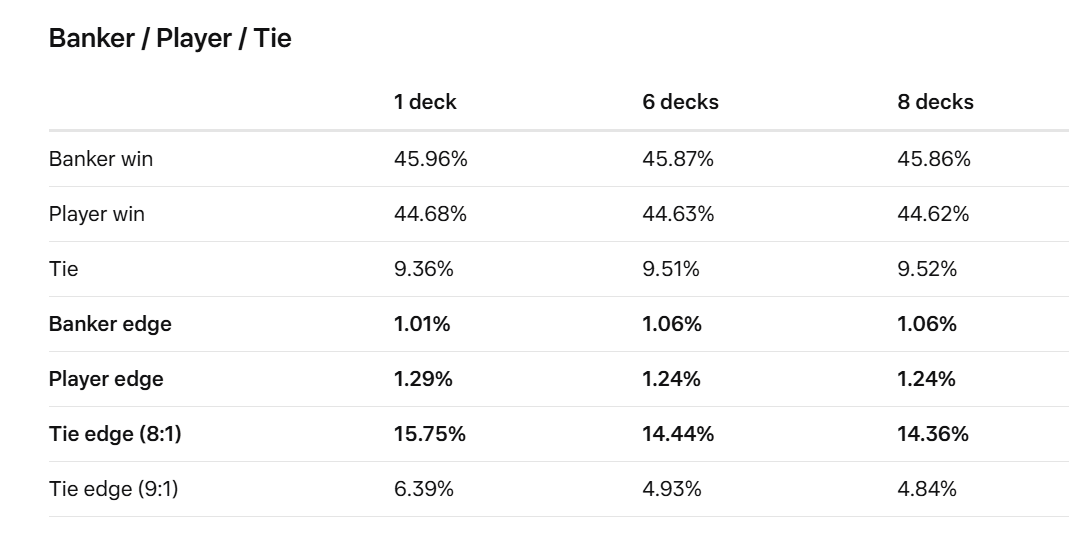
"How many decks are they using?" is the first question sharp players ask at a baccarat table — and for the main bets, the honest answer is that it barely matters. The banker bet's edge moves from 1.01% to 1.06% across the whole range. You would need a laboratory to feel it.
But the question gets interesting in two places: the side bets, where deck count can triple the house edge — and penetration, the variable everyone confuses with deck count, which matters far more than either. Full tables first, then the part most articles skip.
Full probability tables: 1 vs 6 vs 8 decks
All figures from exact combinatorial analysis (Wizard of Odds), standard rules, 5% banker commission, tie pays 8:1, pair bets pay 11:1.
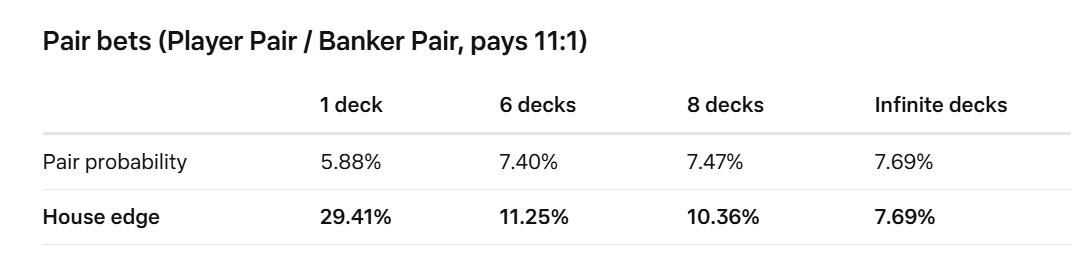
Read that bottom row again. The pair bet's edge goes from 29.41% with one deck to 10.36% with eight. That's not a tweak — that's the difference between a bad bet and a mugging.
Why the differences are tiny (except when they're not)
Why does deck count barely touch the main bets? Because baccarat's drawing rules are rank-based, not count-based: the rules care whether a card is a 7 or a 3, not how many decks produced it. Adding decks just dilutes the removal effect of each dealt card — the shoe behaves a little more like an infinite deck, where every rank is always equally available. The probabilities converge fast: by 6 decks you're already within a hair of the 8-deck numbers.
But pair bets are pure composition bets — they ask "will these two cards match?", and matching depends entirely on how many of each rank remain relative to the total. With one deck, the first card dealt removes a quarter of its rank's remaining copies (3 of 51 left instead of 32 of 416). Fewer copies per rank, fewer possible pairs, same 11:1 payout → the edge explodes to 29.41%. The worked example:
1 deck: P(pair) = 3/51 = 5.8824%. EV = 0.058824 × 11 − 0.941176 × 1 = 0.647059 − 0.941176 = −0.294118 → 29.41% edge
8 decks: P(pair) = 6,448/86,320 = 7.4699%. EV = 0.074699 × 11 − 0.925301 = −0.103614 → 10.36% edge
Same bet, same payout, nearly triple the price — determined entirely by the shoe on the table. If you ever see a single-deck baccarat game offering pair bets, admire the audacity and keep your chips away.
Deck count vs penetration: which matters more?
Here's the new angle, and the one that actually affects your money: penetration — how deep into the shoe the dealer goes before shuffling — matters more than how many decks the shoe holds.
Why? Because every interesting thing in baccarat happens late in the shoe. Card counters don't get their (tiny) edges from fresh shoes; they get them from depleted, lopsided shoes where the remaining composition has drifted far from average. A counter's opportunities live in the last 10–15% of the shoe — which only exists if penetration is deep.
Consider the trade:
6-deck shoe, 90% penetration: the counter sees ~47 cards of skewed composition at the deep end. Real (if small) opportunities on side bets.
8-deck shoe, 70% penetration: the shoe is reshuffled with ~125 cards unseen. The deep, lopsided region — where the money spots live — never gets dealt.
The 8-deck game looks richer in cards but deals you fewer exploitable hands. For the basic-strategy player who never counts, neither matters (see the tables above — the main-bet differences are dust). For anyone tracking composition, penetration is the whole game: it determines how many hands are dealt under skewed conditions, which is the only thing that can ever move an edge.
Standard dealing procedure puts the cut card about 14 cards from the end of the shoe (Wizard of Odds) — deep by industry standards, and one reason baccarat shoes feel endless. But "16 cards from the end" of a 416-card shoe and of a 312-card shoe are different fractions, and some casinos cut much thicker. Always look at where the cut card sits, not just the "8-deck" plaque on the table.
(For the full story of what counters actually do with deep penetration, see our card counting guide.)
How Baccarator adapts to any deck count
This is exactly why a calculator beats a memorized table: the app doesn't care whether you're facing 1, 6, or 8 decks. You tell it the deck count (and it tracks the discards), and every probability — main bets, pairs, ties, all the side bets — is recomputed for your shoe's composition. The tables above are the starting line. The live numbers are the race.
The infinite-deck limit: what online RNG games converge to
Many online RNG (random number generator) baccarat games effectively deal from an "infinite" shoe — every hand drawn as if from a fresh, full deck. The Wizard analyzed this limit too, and it's the cleanest illustration of the convergence story (Wizard of Odds):
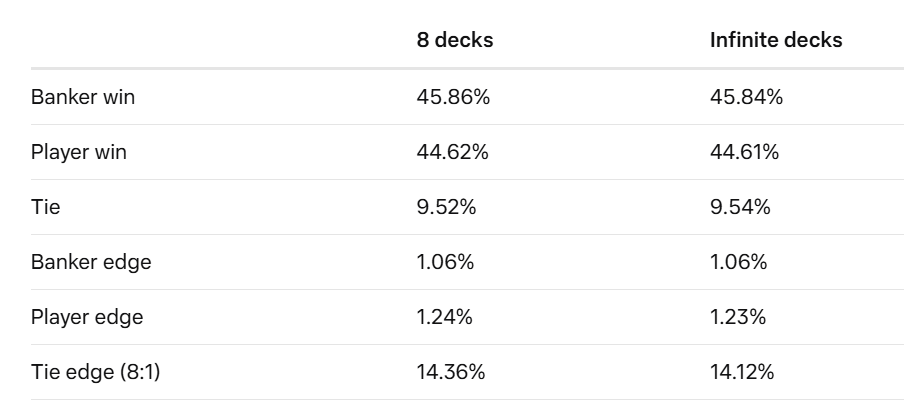
Eight decks is already, for all practical purposes, infinite. The removal effect of a single card from 416 is so dilute that the probabilities have essentially settled. This is why card counting the main bets in baccarat is famously futile — the game was already near its mathematical limit before you started tracking. (Side bets are a different story: their edges move much more with composition, which is why counters target them, not Banker/Player.)
The practical corollary: if you play RNG baccarat online, the 8-deck column in the tables above is your game, forever, every hand. No shoe to track, no penetration to check — and no drift to exploit.
FAQ
1. Should I prefer 6-deck or 8-deck tables?
For the main bets, it makes no meaningful difference (1.06% vs 1.06% on banker). For side bets, check the specific bet's table — pair bets are slightly cheaper at 8 decks (10.36% vs 11.25%), ties slightly cheaper too. But never pick a table on deck count alone; paytables and penetration matter more.
2. Does the burn card / cut card change the odds?
The burn cards at the start of a shoe remove a few cards unseen — mathematically identical to dealing them face-down, so the fresh-shoe probabilities still apply to the first real hand. The cut card's position (penetration) matters for counters, as discussed above, but doesn't change the per-hand math.
3. What's the single most important number in this article?
For most players: the main bets don't care about deck count. For side-bet players: the pair bet's 29.41% single-deck edge. One of those will save you nothing; the other might save you a lot.
Deck count is a footnote for the main bets, a headline for the pair bets, and a distraction from the real question — how deep does this shoe go? Set the decks, watch the penetration, and let the calculator do the rest.
Tell Baccarator your table's deck count and it matches the probability model automatically — live odds, EV, and Kelly sizing on the App Store. Stop guessing, start calculating.
