Baccarat Streaks: How Often Does 6 in a Row Really Happen?
Whenever my parents and I played baccarat together, we watched the same scoreboard and came to opposite conclusions.
They believed in the long dragon. Five or six Bankers in a row, and they wanted to ride it. To them, a streak was the table telling you which way it was leaning.
I thought they had it backwards. My system was to sit and wait. No bets until the sixth Banker (or the sixth Player) in a row, and then I'd start a Martingale on the other side: one unit, double after every loss, keep going until the streak broke. Six in a row already felt rare. A seventh seemed almost impossible.
Years later I built a baccarat probability app, which meant I had to stop trusting my gut and actually count. So I simulated 2,000,000 eight-deck shoes and checked both of us.
A six-hand streak shows up in most shoes
The first surprise was how ordinary long streaks are. A standard eight-deck shoe deals about 82 hands, and roughly 74 of them get decided. The rest are ties, which don't break a streak, same as on the big road.
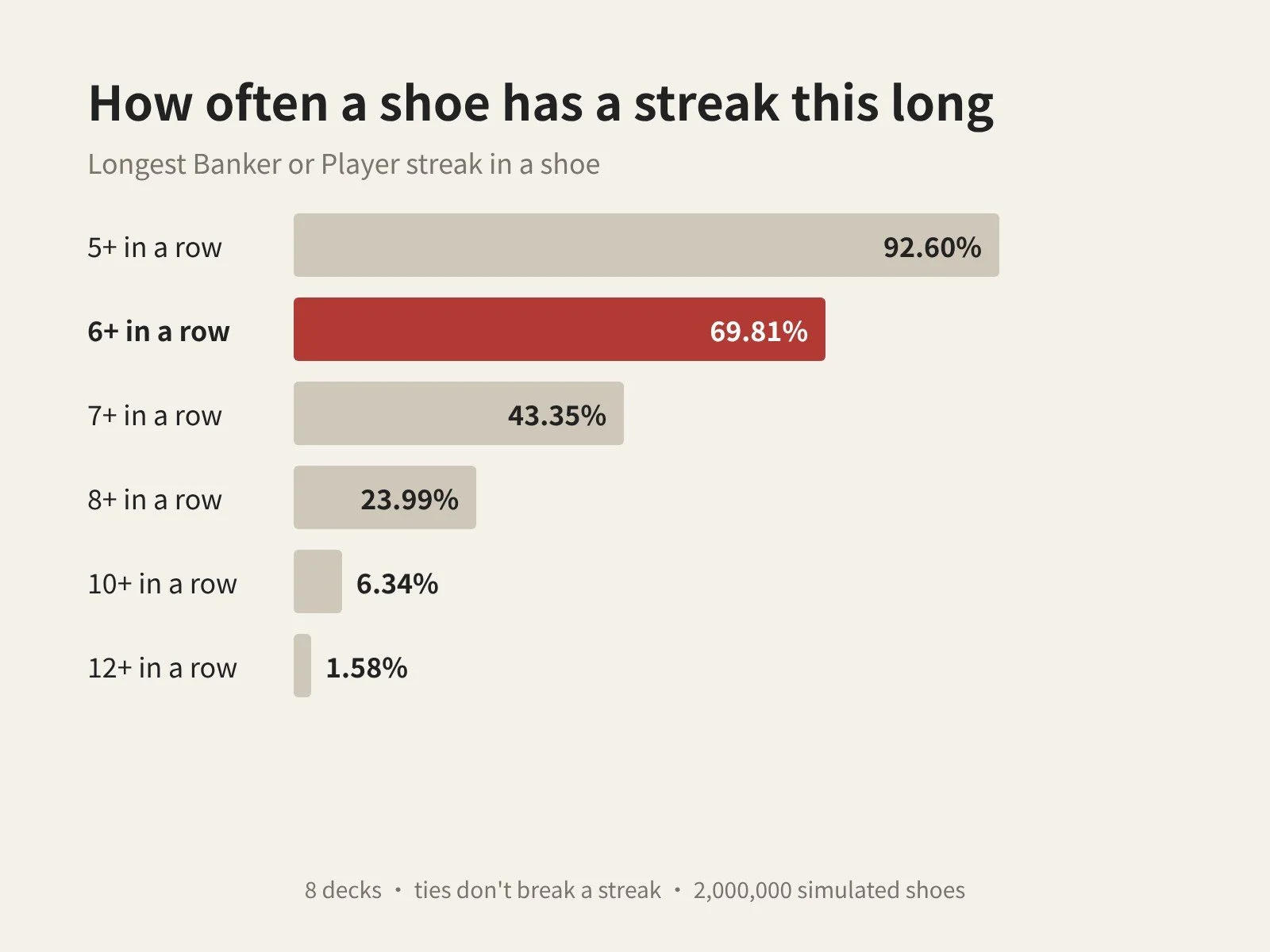
Here's how often the longest Banker or Player streak in a shoe reaches a given length:
| Share of shoes | |
|---|---|
| 5 or more in a row | 92.60% |
| 6 or more in a row | 69.81% |
| 7 or more in a row | 43.35% |
| 8 or more in a row | 23.99% |
| 10 or more in a row | 6.34% |
| 12 or more in a row | 1.58% |
A streak of six or more happens in about 70% of shoes. So the moment I was waiting for wasn't some rare signal. On most nights it was going to show up at least once.
Seven or more still happens in 43% of shoes. You only get into rare territory around 12 in a row, and even that turns up about once every 63 shoes.
What happens on the very next hand
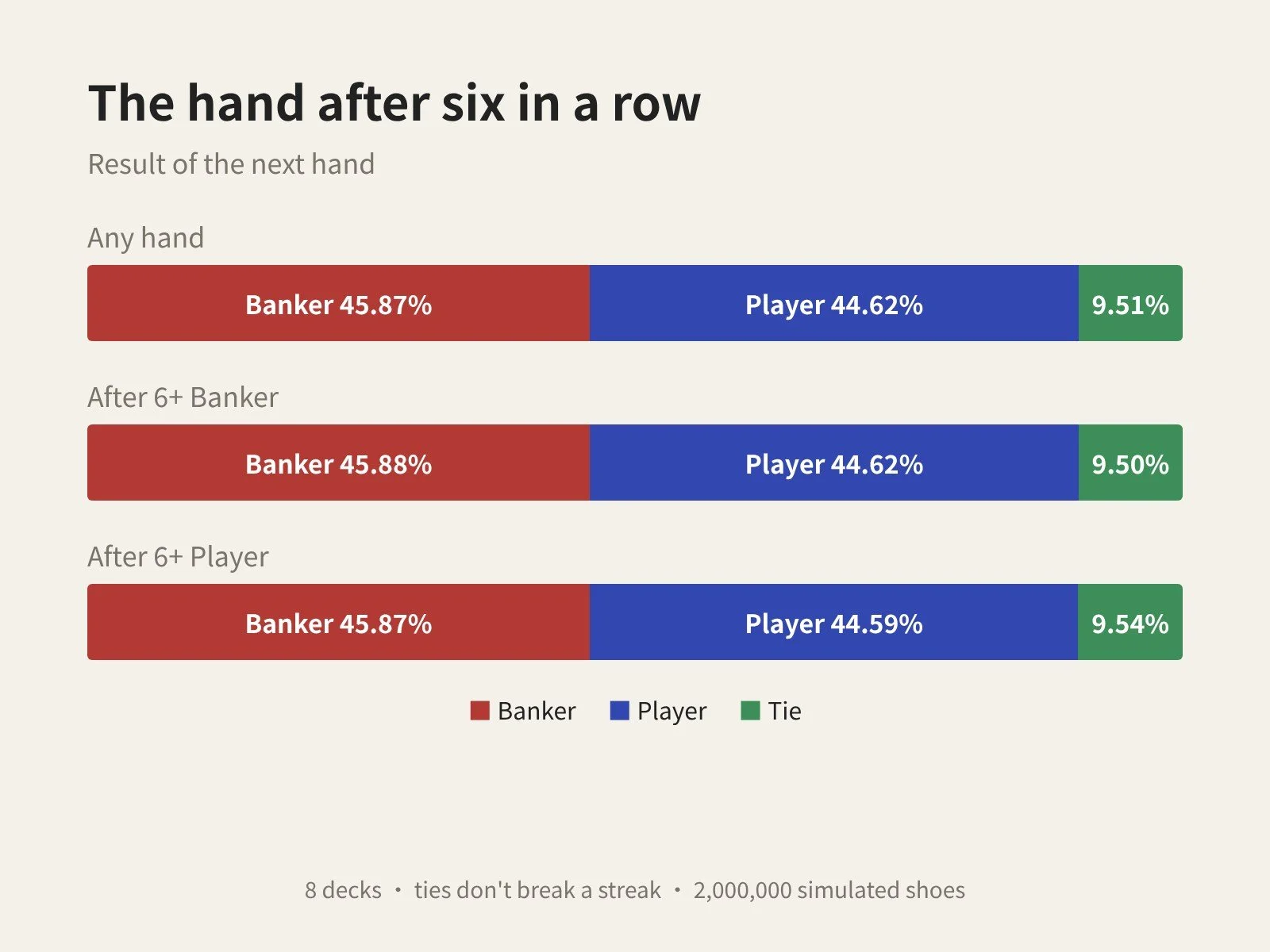
This is the hand my parents and I were both betting on, from opposite sides. If six Bankers in a row means something, the next hand should lean one way.
| Any hand | After 6+ Banker | After 6+ Player | |
|---|---|---|---|
| Banker | 45.87% | 45.88% | 45.87% |
| Player | 44.62% | 44.62% | 44.59% |
| Tie | 9.51% | 9.50% | 9.54% |
After six Bankers in a row, the next hand is still Banker 45.88% of the time. On any hand it's 45.87%. That gap is smaller than the simulation's own noise.
The shoe doesn't remember what it dealt. The only thing that can move the odds is which cards are left, and a streak hardly changes that, because a run of Bankers can come from almost any mix of cards. I worked through this in detail in 【內部連結:/blog/how-remaining-cards-change-baccarat-odds|how the remaining cards change baccarat odds】.
Why my Martingale felt like it worked
Here's the uncomfortable part. My system won most of the time, and that's exactly why I trusted it.
In the simulation I gave the Martingale eight steps: 1, 2, 4, 8, 16, 32, 64 and 128 units, roughly the gap between a table's minimum and maximum bet. It started right after the sixth hand of a streak and bet against it.
99.64% of sequences ended in a win. The other 0.36%, about 1 in 280, lost all eight bets and took 255 units with them.
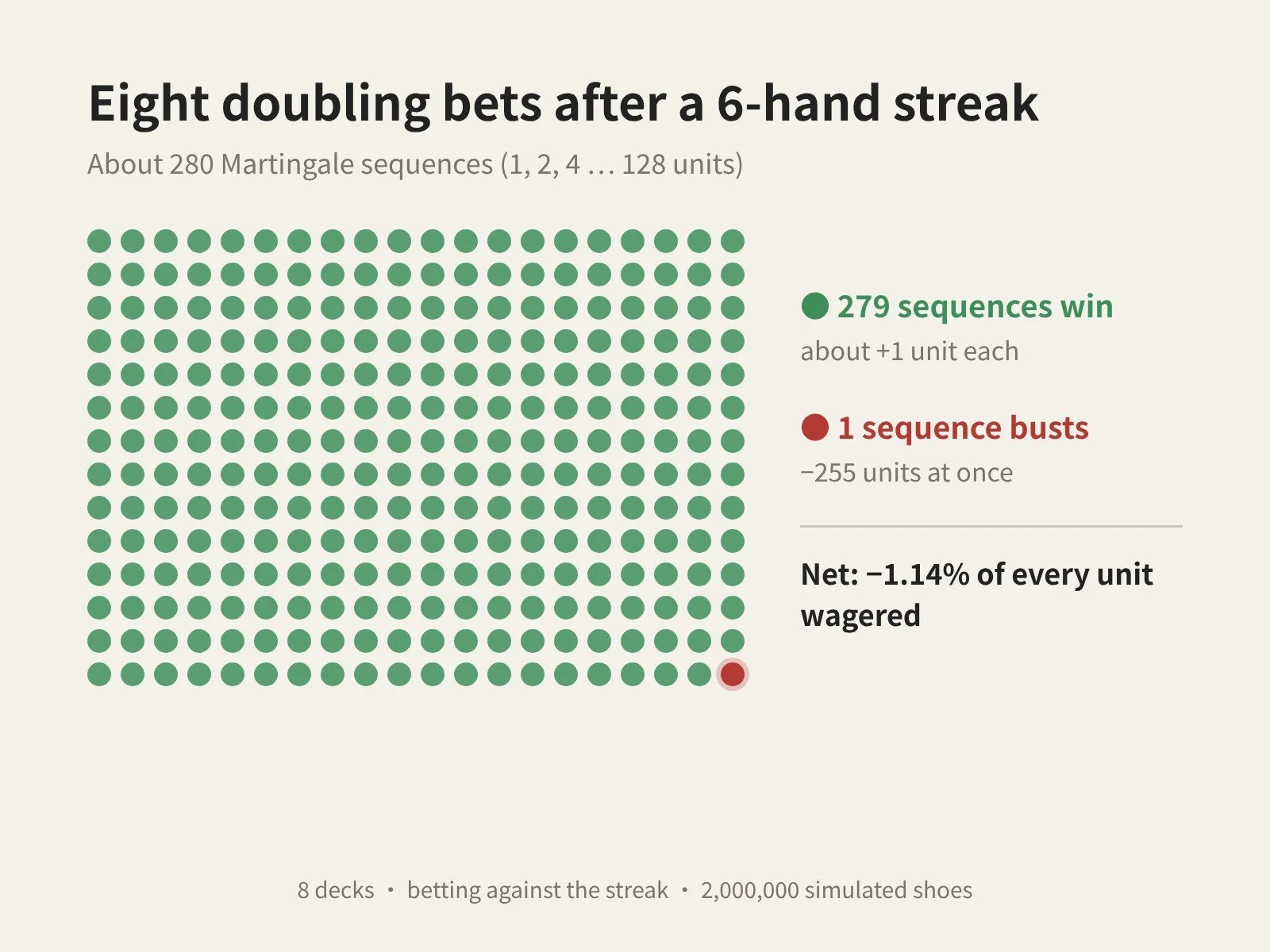
A win is usually worth one unit. A loss is worth 255. Across 2 million shoes, the system lost 1.14% of every unit wagered, right where the regular Banker and Player bets sit.
There's an extra trap on the Banker side. Banker pays 0.95 to 1 because of the 5% commission, so a late win doesn't fully cover what came before. If the win comes on your sixth bet, you've "won" and you're still down 0.6 units. Win on the eighth bet and you're down 5.4.
So who was right, me or my parents?
Neither of us. I ran my parents' approach through the same simulation: follow the streak after six, same eight-step Martingale. It lost 1.23% per unit wagered. Mine lost 1.14%. When the losses are this lumpy, a gap that size is mostly noise.
Each bet keeps its own house edge. Waiting six hands or doubling after a loss doesn't change which bet you're actually making.
Looking back, we were both assuming the shoe remembers the last six hands. It doesn't.
That's a big part of why I built Baccarator the way I did. It only looks at the cards still in the shoe, so you can watch a long streak go by and see the probabilities barely move.
Watch a streak go by without moving the odds
If you've ever stared at six in a row and felt sure about the next hand, try it in Baccarator. Enter the cards as they're dealt and the app recalculates Banker, Player and Tie after every card. It's free, you practice with virtual chips, and no real money is involved.
Download Baccarator Free|https://apps.apple.com/app/id6740475592
FAQ
1. What are the odds of 6 Bankers in a row in baccarat?
For any specific six decided hands, about 1.69% (ties don't count). Six Players in a row is about 1.44%. Across a whole eight-deck shoe, though, a streak of six or more on either side shows up in about 70% of shoes.
2. Does a long streak make the other side more likely?
No. In 2 million simulated shoes, the hand after six Bankers in a row was Banker 45.88% of the time and Player 44.62%, the same as any other hand within simulation noise.
3. Does the Martingale work in baccarat?
It wins small most of the time and loses big once in a while. With eight doubling steps, about 1 in 280 sequences loses 255 units, and overall it lost about 1.1% to 1.2% of everything wagered, the same as the bets underneath it. EV is a long-run average, and the next hand can still lose.
Baccarator is a math tool for education. No real-money gambling. 21+ only.
