Dragon Tiger is baccarat cut down to one card per side: the higher card wins. It is faster and simpler, but it costs more. With 8 decks, the two cards tie 7.47% of the time, and a tie usually takes half of a Dragon or Tiger bet. That gives Dragon and Tiger a house edge of 3.73%, more than three times the 1.06% on baccarat's Banker bet.
Here is how the game works and where that gap comes from.
How Dragon Tiger works
The dealer puts one card face up on the Dragon side and one on the Tiger side. The higher card wins. Aces are low and Kings are high, and suits don't matter for the main bets. If both cards have the same rank, it is a Tie.
There is no drawing chart, no third card and no commission. A Dragon or Tiger win pays 1 to 1.
Dragon Tiger odds with 8 decks
With 416 cards, the second card matches the first card's rank in 31 of the remaining 415 cases. That is a Tie rate of 7.47%. The other 92.53% splits evenly, so Dragon wins 46.27% and Tiger wins 46.27%.
Since the game is perfectly symmetric, neither side is better. The whole house edge comes from what happens on a Tie.
In Dragon Tiger the Tie is the house edge. Dragon and Tiger are exact mirror images.
Dragon Tiger vs baccarat house edge
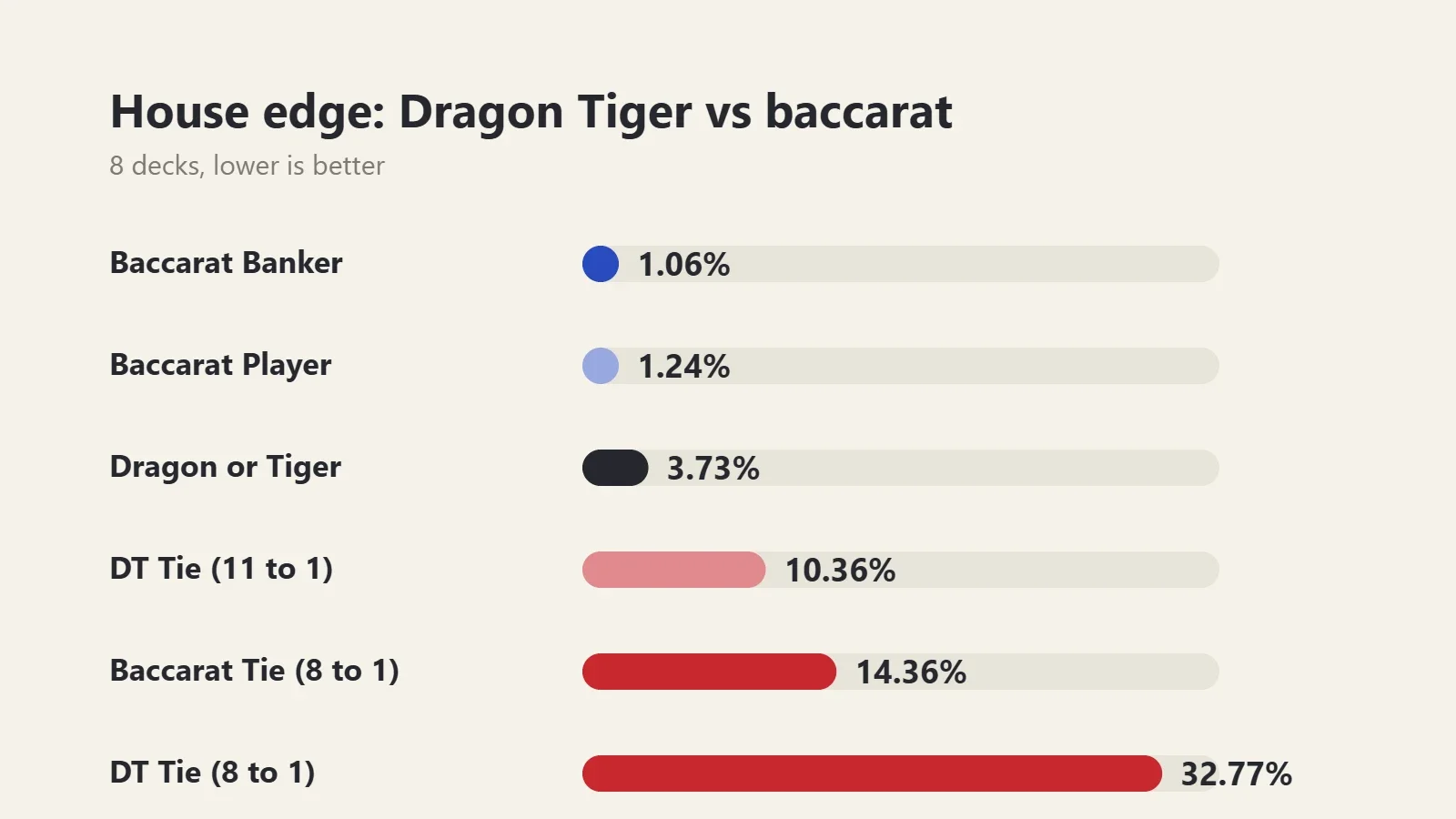
| Pays | House edge | |
|---|---|---|
| Baccarat Banker | 0.95 to 1 | 1.06% |
| Baccarat Player | 1 to 1 | 1.24% |
| Dragon or Tiger (half lost on a Tie) | 1 to 1 | 3.73% |
| Dragon Tiger Tie | 11 to 1 | 10.36% |
| Baccarat Tie | 8 to 1 | 14.36% |
| Dragon Tiger Tie | 8 to 1 | 32.77% |
The usual rule is that a Tie loses half of a Dragon or Tiger bet, which gives the 3.73% above. Some tables take the whole bet on a Tie, and then the house edge doubles to 7.47%. It is worth reading the table rules before comparing.
The Tie bet itself varies a lot. At 11 to 1 it costs 10.36%; at 8 to 1 it jumps to 32.77%, because the same-rank chance is lower than baccarat's Tie. For comparison, the baccarat Tie at 8 to 1 is 14.36%, explained in tie bet odds and house edge.
Same 1 to 1 payout, but Dragon or Tiger costs about three and a half times what Banker does.
Speed matters too
A Dragon Tiger round uses two cards, while a baccarat hand uses four to six. So a shoe lasts far more rounds, and each round is quick. Expected loss per bet is one thing; the number of bets per hour multiplies it.
At the start of a fresh shoe every bet in both games has a negative expected value. Remaining cards can shift things a little, and betting systems can't change that. More on baccarat's own variants is in baccarat variants.
Track baccarat odds, not guesses
Baccarator is built for baccarat, not Dragon Tiger. If you want to see how baccarat's odds shift as a shoe goes on, that is what it does.
After each hand you enter the cards and tap Calculate, and Baccarator recalculates the odds and expected value for Banker, Player, Tie, pairs and side bets from the cards still in the shoe. If a bet briefly turns positive, it shows a Kelly sizing suggestion. That only appears when expected value is positive, it is a long-run average, and the next hand can still lose. Positive moments are rare and short. You can choose 6 or 8 decks and practice with virtual chips, with no real money involved.
Dragon Tiger vs baccarat FAQ
What is the house edge in Dragon Tiger?
With 8 decks and half lost on a Tie, Dragon or Tiger has a 3.73% house edge. If a Tie takes the whole bet, it is 7.47%.
Is Dragon Tiger the same as baccarat?
No. Dragon Tiger deals one card per side and the higher card wins. Baccarat deals two or three cards per side and counts the total.
What are the odds of a tie in Dragon Tiger?
About 7.47% with 8 decks, since 31 of the remaining 415 cards match the first card's rank.
Baccarator is a math tool for education. No real-money gambling. 21+ only.
