On a standard table with 5% commission, yes, Banker is the better of the two main bets. Its house edge is 1.06%, compared with 1.24% on Player. But "better" only means you lose a little more slowly. Both bets have a negative expected value at the start of a shoe, and on a no-commission table the order flips: Banker rises to 1.46%, which is worse than Player.
Here is why, and where the line sits.
Why Banker is the better bet even after the 5% commission
Banker wins 45.86% of hands, Player 44.62%. The gap comes from the drawing rules. Player acts first by a fixed rule, and Banker decides afterward, knowing what Player's third card was. That small information advantage is worth about 1.2 percentage points.
The 5% commission is there to take most of that back. It takes back almost all of it, but not quite.
Banker wins 50.68% of the hands that aren't Ties. The commission trims that edge but doesn't erase it.
A quick calculation shows how close it is. Commission would have to be about 5.39% before Banker and Player cost exactly the same. At 5%, Banker stays slightly cheaper.
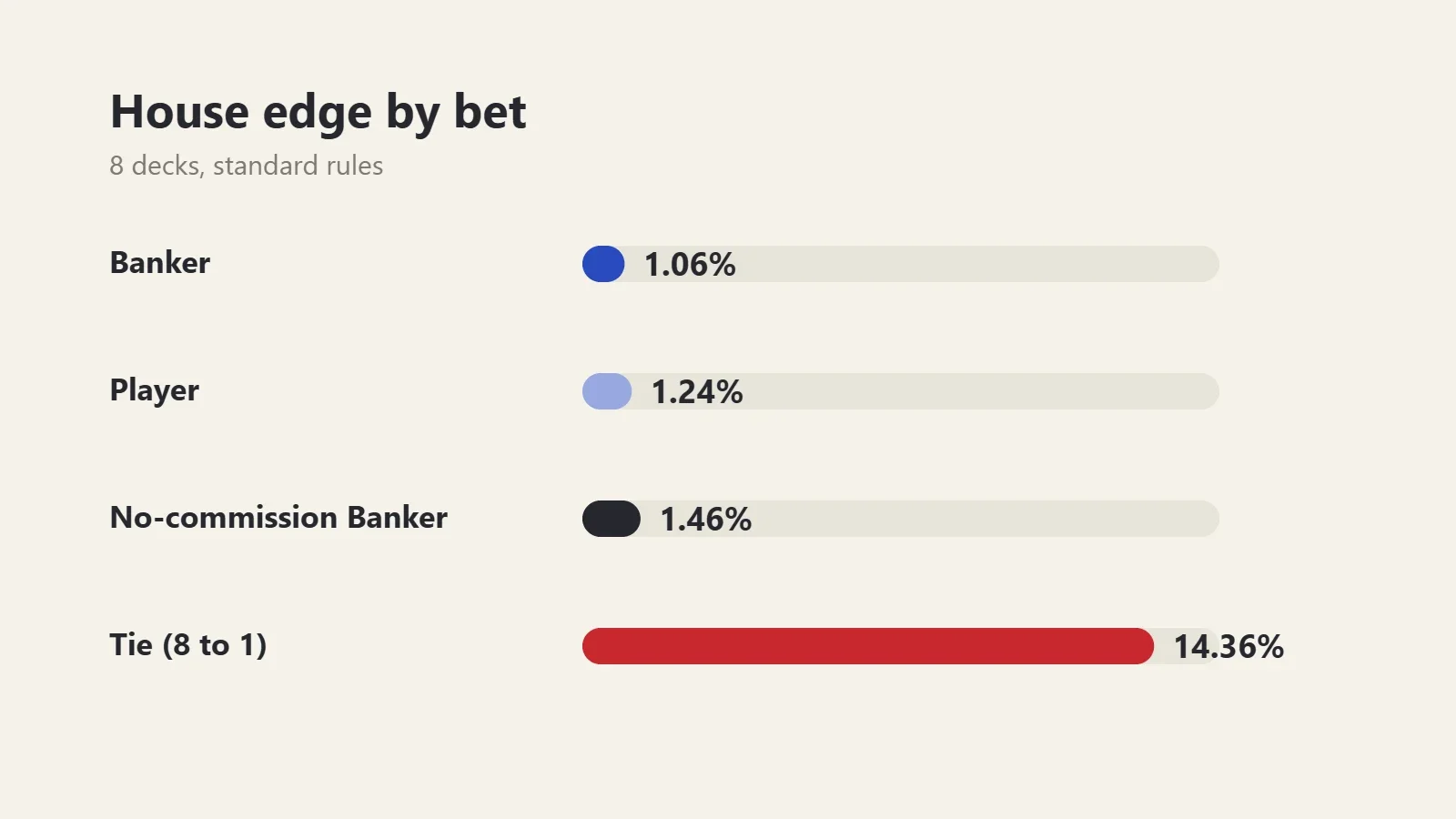
| Pays | House edge | |
|---|---|---|
| Banker | 0.95 to 1 (5% commission) | 1.06% |
| Player | 1 to 1 | 1.24% |
| Banker, no-commission table | 1 to 1, half on a winning 6 | 1.46% |
| Tie | 8 to 1 | 14.36% |
The difference between Banker and Player is 0.18 percentage points. Across 1,000 bets of 10 each, that is about 18 in expected cost, small next to the normal swings of a session. The full comparison is in baccarat Banker vs Player.
No-commission baccarat: when Banker is not the better bet
No-commission tables pay Banker 1 to 1, except a Banker win with 6 pays half. That rule costs more than the commission it replaces. Banker's house edge goes up to 1.46%, while Player stays at 1.24%. So on these tables Player is the cheaper bet. The rule details are in no-commission baccarat.
"Always bet Banker" is only true on tables that charge the standard 5% commission.
Can the remaining cards make Player better?
The odds move a little as cards leave the shoe, and in principle the balance between Banker and Player shifts with them. In practice the main bets barely move. Some side bets can briefly swing from negative to positive expected value, but Banker and Player rarely move enough to matter. At the start of a fresh shoe every bet has a negative expected value. Betting systems can't change that, and neither can patterns on the scoreboard.
And the Tie, at 14.36%, is more than ten times as expensive as either one.
Check Banker and Player hand by hand
If you are curious how close Banker and Player stay through a shoe, you can watch it happen.
After each hand you enter the cards and tap Calculate, and Baccarator recalculates the odds and expected value for Banker, Player, Tie, pairs and side bets from the cards still in the shoe. If a bet briefly turns positive, it shows a Kelly sizing suggestion. That only appears when expected value is positive, it is a long-run average, and the next hand can still lose. Positive moments are rare and short. You can choose 6 or 8 decks and practice with virtual chips, with no real money involved.
Should you always bet Banker FAQ
Should you always bet Banker in baccarat?
On a standard table with 5% commission, Banker has the lowest house edge at 1.06%, against 1.24% on Player. It is still a negative expected value bet, and on no-commission tables Player is cheaper.
Why bet on Banker in baccarat?
Because Banker draws last under the rules and wins 45.86% of hands against Player's 44.62%. Even after the 5% commission, that leaves Banker slightly cheaper.
Is it better to bet Banker or Player?
On a commission table Banker costs less; on a no-commission table Player costs less. The gap is small either way, and both lose over the long run.
Baccarator is a math tool for education. No real-money gambling. 21+ only.
