Panda 8 vs. Dragon 7 Side Bets: Probabilities, Payouts and House Edge
Walk up to an EZ Baccarat table and you'll see two prominently advertised side bets: Dragon 7 and Panda 8, paying 40 to 1 and 25 to 1. They look like the exciting part of the game. The math says they're the expensive part. Here's the full comparison.
Where these bets come from
Dragon 7 and Panda 8 were created for EZ Baccarat, a no-commission variant. In EZ Baccarat, winning Banker bets pay even money with no 5% commission — but there's a catch: if Banker wins with a three-card total of 7, the Banker bet pushes instead of winning. That rule replaces the commission and keeps the game's economics intact (the Banker bet's edge lands around 1.02%).
The two side bets let players wager on exactly those signature events:
Dragon 7: wins when Banker wins with a three-card total of 7. Pays 40 to 1.
Panda 8: wins when Player wins with a three-card total of 8. Pays 25 to 1.
You may also see Dragon 7 called Tiger 7 or Golden 7, and Panda 8 called Golden 8 or Kirin — same bets, different branding.
The numbers, side by side
All figures below are for an eight-deck game, from combinatorial analysis by Wizard of Odds — Baccarat Side Bets:
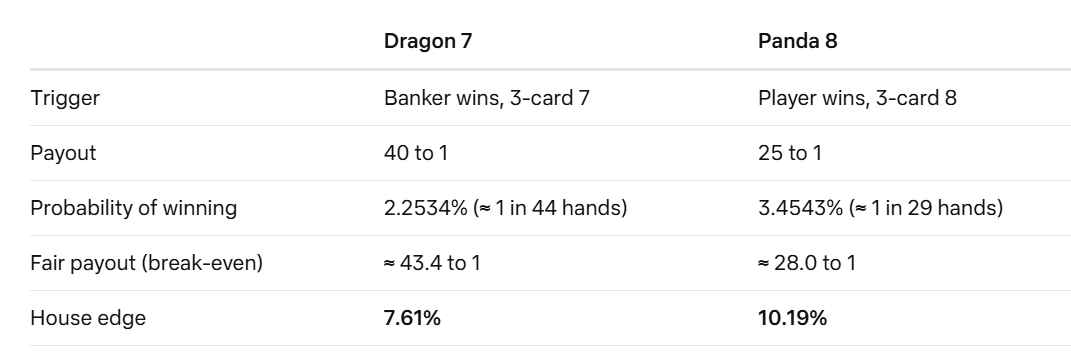
The verdict is unambiguous: Dragon 7 is the better of the two, costing about $7.61 per $100 wagered versus Panda 8's $10.19. But "better" is relative — both cost roughly 6–8× more than the Banker or Player main bets (1.06% and 1.24%).
Why the payout falls short of fair odds
This is the key insight for any side bet. Dragon 7's true probability is 2.2534%, so a fair payout would be about 43.4 to 1. The casino pays 40. That missing 3.4 units is the entire 7.61% edge, concentrated into one number. Same story for Panda 8: fair would be ~28 to 1, paid 25.
Casinos aren't hiding this — the math is published. They're pricing entertainment: the thrill of a 40-to-1 payout is worth, to most players, more than its $7.61-per-$100 cost. As long as you see it as an entertainment expense rather than an investment, that's a coherent choice.
Watch out for pay-table downgrades
Not all Dragon 7 bets pay 40 to 1. A variant called Phoenix pays only 37 to 1 on the same event — and the house edge jumps to 14.37%, nearly double. Always read the felt: in side bets, the pay table is the game. A few points of payout difference can double your expected cost.
Where you'll find them
Dragon 7 and Panda 8 appear wherever EZ Baccarat is dealt — many Las Vegas and Asian-market casinos, plus online live-dealer tables using the EZ format. Because they're side bets, they're optional: you can play the excellent ~1.02–1.24% main game while ignoring them completely. Some tables also offer the bets under the alternate names listed above, occasionally with tweaked pay tables — which, as the Phoenix example shows, is exactly when you should check the numbers before playing.
A note on card counting these bets
These two side bets are among the few baccarat wagers researchers consider theoretically countable. Analyst Eliot Jacobson has published detailed effect-of-removal studies for both (Panda 8 analysis), showing that deep in a shoe, with the right cards depleted, either bet can occasionally flip to positive expectation. In practice, this demands perfect multi-card tracking, rare opportunities, and casinos that tolerate it — a combination that makes it a research curiosity rather than a practical approach for nearly everyone. (Our card counting article covers this in full.)
The bottom line
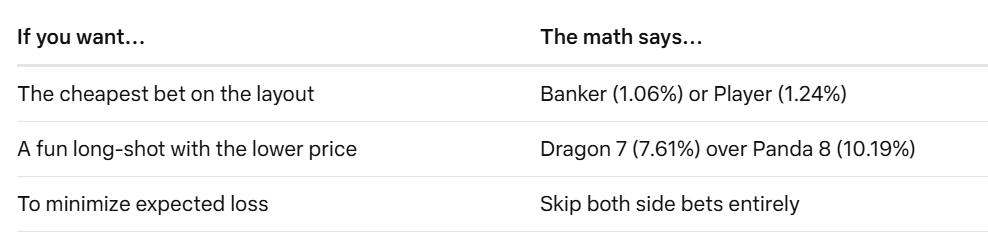
Neither bet will ever be "due," and no pattern of past Dragons predicts the next one. What the numbers give you is a price list — and with it, the ability to decide deliberately how much excitement you're willing to buy.
If you want those prices computed live from the actual shoe in front of you — side-bet probabilities and EV updated as cards are dealt — Baccarator does exactly that, on the App Store. Stop guessing, start calculating.
