Big and Small Side Bets: The Lowest-Edge Side Bets in Baccarat?
Most baccarat side bets are priced like airport snacks — you pay for the excitement, not the value. Big and Small are the exception that proves the rule: they're the only side bets whose house edge stays under 6%. In the world of 10–17% pair bets and 14% tie bets, that's practically a bargain.
But "best of a bad bunch" deserves scrutiny, not celebration. Here's how Big and Small work, what they really cost, and the honest bottom line.
Rules: 4 cards = Small, 5–6 cards = Big
Forget the hand totals for a moment — these bets don't care who wins. They only count how many cards get dealt in the hand:

Four-card hands happen when both sides stand pat — naturals, or 6/7 vs 6/7 standoffs. Five- and six-card hands happen whenever the drawing rules kick in. Since third cards are drawn often, Big hits most of the time — which is exactly why it pays less than even money.
One caution before the math: paytables vary. The figures below are for the widely-analyzed Playtech 6-deck version (Wizard of Odds); some casinos pay Big at different odds, which changes the edge. Always read the felt — on these bets, the paytable is the bet.
The math: 4.35% (Big) / 5.27% (Small) house edge
Small (4 cards, pays 3:2), 6 decks — the full arithmetic:
4 cards dealt: probability 0.378925 → 0.378925 × 1.5 = +0.568388
5 or 6 cards: probability 0.621075 → 0.621075 × 1 = −0.621075
EV = 0.568388 − 0.621075 = −0.052688 → 5.27% house edge
Big (5–6 cards, pays 0.54:1), 6 decks: probability of winning 61.1075%, house edge 4.35445% — about $4.35 per $100 wagered.
Put those hit rates in human terms: Small wins about 38% of hands — better than one in three, which is why it feels reasonable. Big wins about 61% of hands — nearly two in three — but pays a meager 0.54 to 1, so the frequent wins don't cover the frequent losses. Both bets are priced the way insurance is priced: you're paying a steady premium for the shape of the gamble, not for value.
Why they're the "least bad" side bets
Line them up against the competition and the gap is stark (standard paytables, Wizard of Odds):
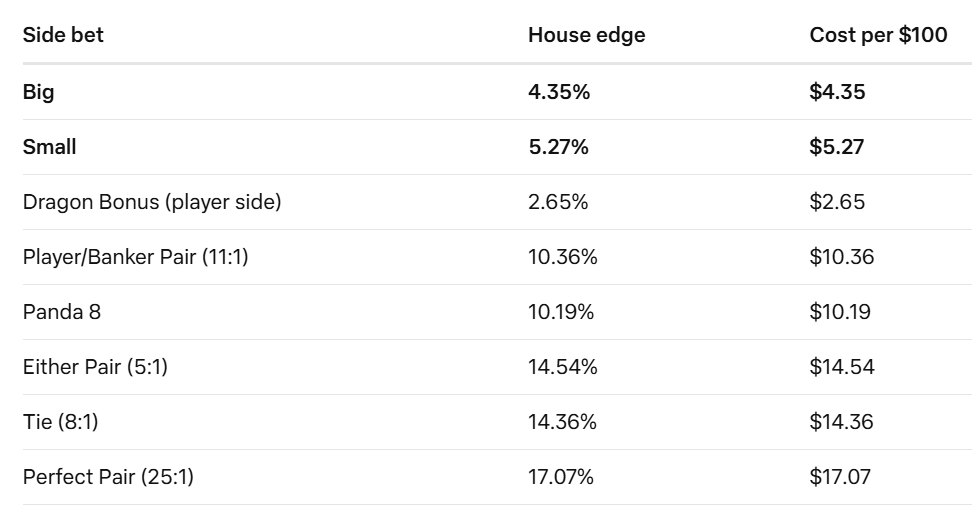
Two observations. First, Big and Small genuinely are among the cheapest side bets available — less than half the price of pair bets. Second, the Dragon Bonus's player side (2.65%) undercuts them both, so "lowest-edge side bet" depends on which side of the Dragon table you're on. The honest title for Big/Small is "cheapest card-count side bets" — a narrower crown, but a real one.
Why are they so much cheaper than pair or tie bets? Because they're high-probability bets. The casino's margin on a 61%-hit-rate bet doesn't need to be large to be profitable — the edge compounds across constant action. Low-probability bets need huge edges to earn their keep; high-probability bets can get away with small ones. It's the same reason the banker bet (45.86% hit rate) costs 1.06% while the tie (9.52%) costs 14.36%.
Still worse than Banker: the honest conclusion
Here's the part Big/Small fans skip: $4.35 per $100 is still four times the banker's $1.06. The "least bad side bet" framing is accurate and also a trap — it invites the conclusion that Big/Small are good bets. They're not. They're the least overpriced item on an overpriced menu.
The rational uses for Big and Small:
Entertainment budgeting. If you want side-bet action, these minimize the hourly cost of that entertainment. $4.35 per $100 is a fair price for a thrill — just know it's a price, not an investment.
Low-variance filler. Big wins 61% of the time, so it smooths out a session's swings. Some players use it as a hedge against boredom, not against losses.
Never as a "system." Betting Big every hand doesn't change the 4.35% — it just guarantees you pay it at maximum speed.
The hierarchy never changes: Banker (1.06%) first, Player (1.24%) second, and every side bet — including these two — a distant third. Big and Small win the side-bet division. They don't get promoted. The smartest use of this article isn't picking between Big and Small; it's knowing their price so the next time someone calls them "free money," you can smile and keep your chips where the math is kindest.
Paytable variants: the Atlantic City 4-5-6
The Big/Small family has a cousin worth knowing: the 4-5-6 bet, once seen at the Atlantic City Hilton, which splits the card counts into three separate wagers instead of two (Wizard of Odds, six decks):
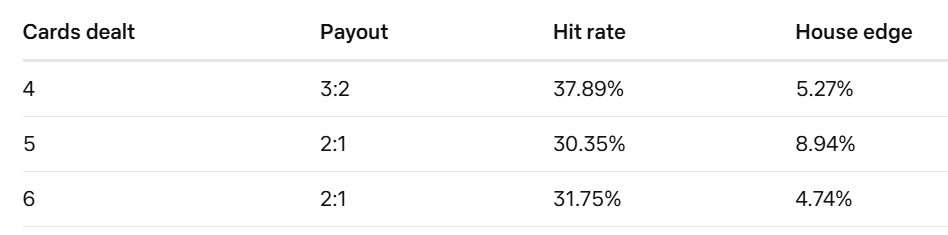
The 4-bet is identical to Small (same 37.89%, same 5.27%). But splitting 5 and 6 apart exposes something interesting: the 5-card bet at 2:1 carries an 8.94% edge — nearly double the bundled Big. Bundling 5+6 together at 0.54:1 averages down the price. It's a neat illustration of how bet construction, not just payouts, determines the edge.
Where you'll find Big and Small
These bets are a Macau and online staple — the Wizard's analysis covers the Playtech online version, and the bets are ubiquitous in Macau's baccarat pits. They're rarer in US brick-and-mortar casinos, where pair bets and Dragon Bonus dominate the felt. If your local casino doesn't offer them, the online live-dealer tables from major providers almost certainly do.
FAQ
1. Is Big or Small the better bet?
Big: 4.35% vs Small's 5.27%. Big wins more often (61% vs 38%) and costs less per dollar. If you're choosing between the two, Big is the answer — but see the honest conclusion above before celebrating.
2. Do Big/Small odds change mid-shoe?
Yes, like everything composition-based. Late in a shoe heavy in 6s and 7s (cards that make hands stand), four-card hands get likelier and Small's edge shrinks; in a shoe rich in low cards that force draws, Big's price improves. A live calculator tracks this — the fresh-shoe numbers are just the starting point.
3. Can I hedge by betting both?
Betting Big and Small simultaneously covers all outcomes (every hand deals 4, 5, or 6 cards) — and guarantees you pay both edges on every hand. It's the most expensive way to win small amounts frequently. Hedging doesn't reduce the house edge; it just ensures you pay it.
If you're going to play side bets, play the cheapest ones — but check the ranking first, because it changes with the paytable on your specific felt.
Baccarator's side-bet EV leaderboard ranks every available wager live, so you always know which bet is actually cheapest. Free on the App Store. Stop guessing, start calculating.
