Dragon Bonus Side Bet: Odds, Payouts and the Real House Edge
The Dragon Bonus is the most popular baccarat side bet in the world — a wager that your chosen hand won't just win, but win big. Blowouts pay up to 30 to 1. It feels like getting paid extra for dominance. And on the player side, it's genuinely one of the fairest side bets ever designed.
But bet it on the banker side — same paytable, same felt — and the price nearly quadruples. Why? Because of a quirk buried in the drawing rules that makes bankers win ugly. Here's the full paytable, the real numbers, and the strangest asymmetry in baccarat.
How Dragon Bonus works
The Dragon Bonus (sometimes labeled "Phoenix Bonus" — same bet) is simple: pick Player or Banker. If your side wins, you get paid according to the margin of victory — the bigger the blowout, the bigger the payout:
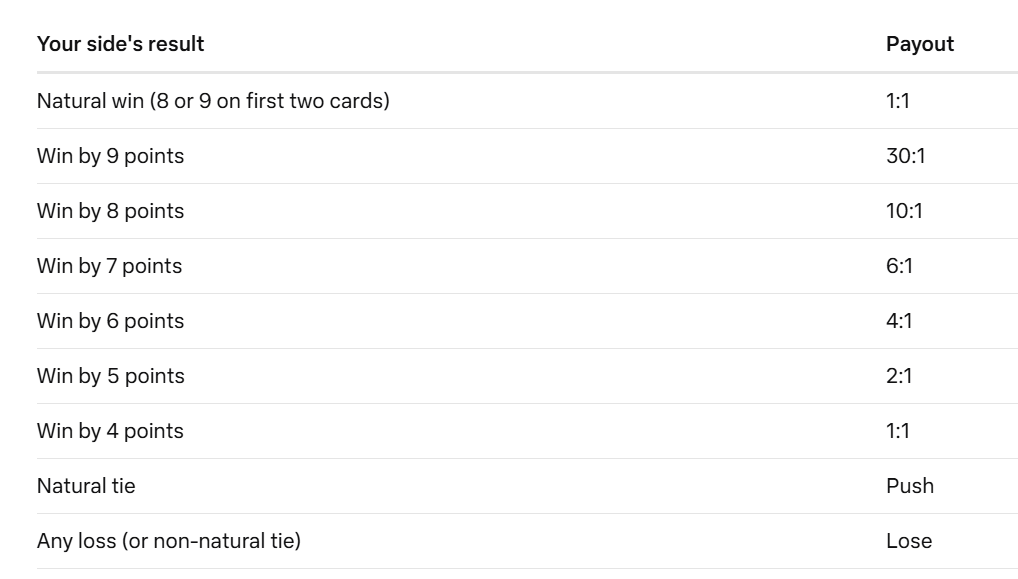
(Paytable per Wizard of Odds, eight decks.)
Note the fine print: non-natural ties lose. Your side has to actually win — a hard-fought 7–7 that isn't natural pays nothing. The bet is a pure blowout wager, and most hands aren't blowouts: on the player side, the losing row alone eats 69.22% of all hands.
The real numbers: 2.65% (Player) vs 9.37% (Banker)
Here's the Wizard's full return breakdown for the player side (eight decks) — every row of the paytable, with its exact probability:
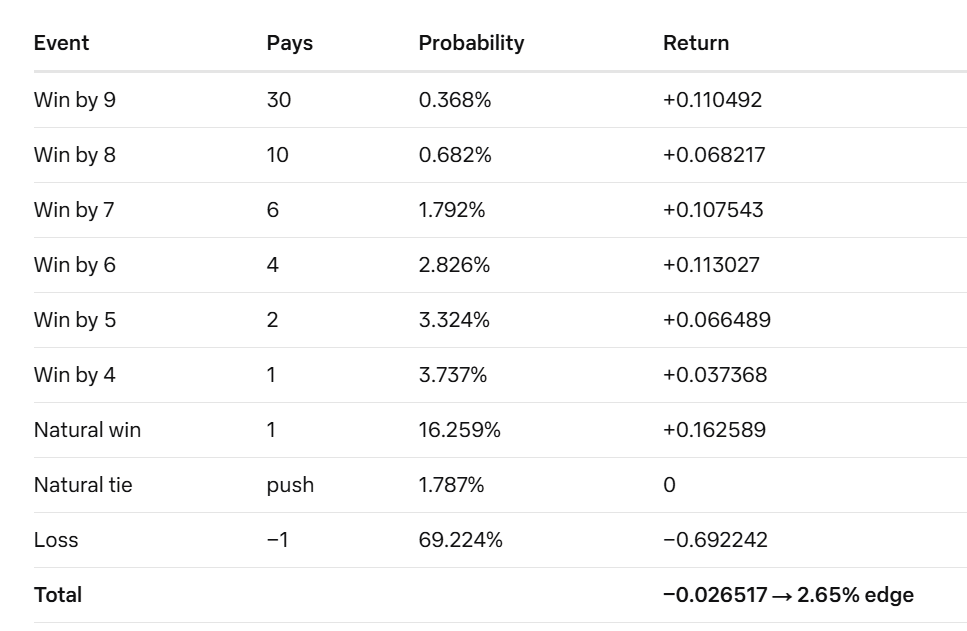
Add the return column yourself and you get −2.65% — that's the whole house edge, built row by row. Notice something lovely: the natural-win row (16.26% of hands at 1:1) contributes +0.1626 of return, doing quiet heavy lifting while the glamorous 30:1 row contributes +0.1105. The boring payouts pay for the exciting ones.
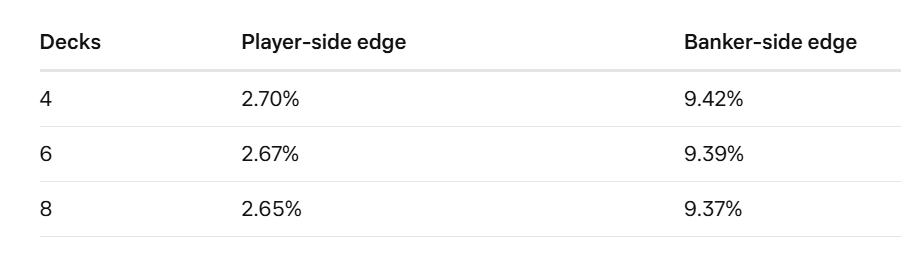
Now the banker side, same paytable: 9.37% house edge. Nearly four times the price. And it barely moves with deck count:
Why the two sides differ so much
This is the best story in side-bet design. The banker's drawing rules — the same positional advantage that makes the banker bet good — make banker wins come disproportionately by small margins. The banker draws to hands like 4, 5, and 6 that the player side would stand on, eking out narrow victories: exactly the margins (win by 4, 5, 6) that the Dragon Bonus pays worst for.
As game designer "Paigowdan" explained it on the Wizard of Vegas forums: banker hands "win more often with winning 4's, 5's and 6's, hands that were drawn to, but win by a smaller (lower paying) margin." The same drawing rules that give the banker a higher win rate give it a lower average margin of victory. One paytable, two different distributions of blowouts — and the price differs by nearly 7 percentage points. Side-bet designers call this the tricky balancing act of baccarat: you can't use one paytable for both sides without one side being mispriced. (Source)
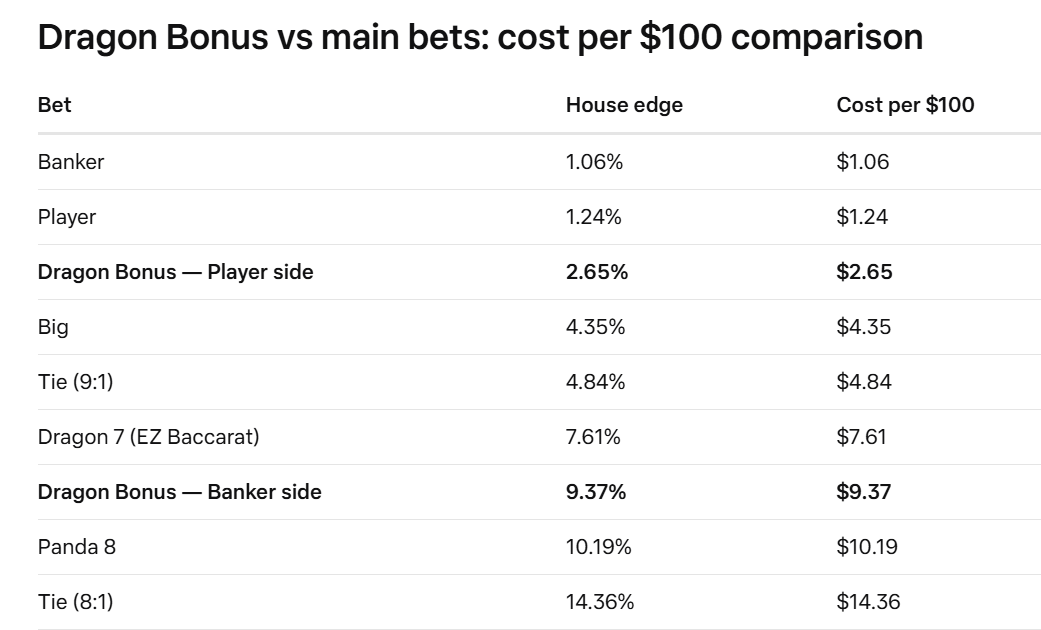
The player-side Dragon Bonus at 2.65% is the cheapest widely-available side bet in baccarat — cheaper than most roulette bets. The banker side at 9.37% is priced like an ordinary sucker bet. Same name on the felt. Always check which side the edge belongs to before you sit down.
Can it ever be +EV?
In theory, the same logic that governs every card-counted side bet applies: deep in the shoe, with the right cards removed, the distribution of winning margins shifts, and a 2.65% baseline edge is small enough that skewed compositions can flip it. Researchers have documented countable edges on baccarat side bets with similar profiles (see the analyses of the Dragon 7 and Panda 8 bets, Wizard of Odds).
In practice: the edge is small, the qualifying shoes are rare, and you'd need to track the composition precisely while the casino watches you not play for an hour and then suddenly bet. For 99.9% of players, the actionable version of this question is simpler — play the player side, never the banker side, and treat the 2.65% as the price of the entertainment. Our card counting guide covers what advantage play in baccarat realistically looks like.
Don't confuse it with the Dragon 7
The names are a trap. Two different bets, two different games:
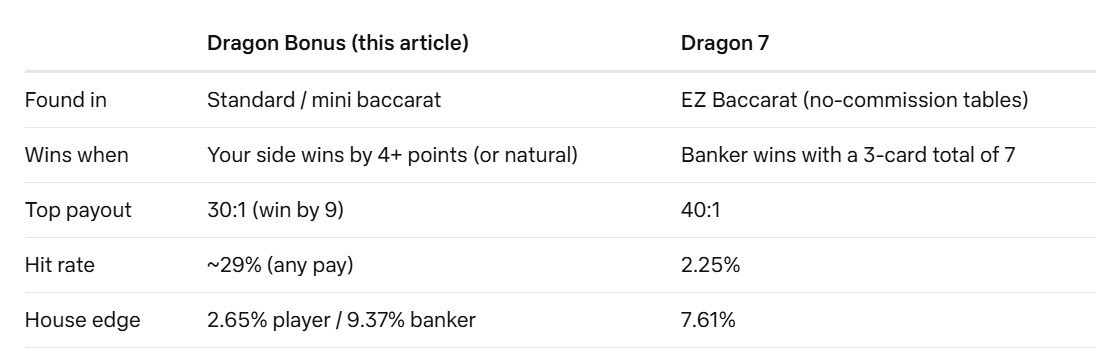
The Dragon 7 is a lottery ticket: 2.2534% hit rate, 40:1 payout, 7.61% edge (Wizard of Odds). The Dragon Bonus is a margin wager that pays something on nearly a third of hands. If a table offers both, they're different circles on the felt — check which one your chips are actually on.
FAQ
1. Should I bet Dragon Bonus on player or banker?
Player, always — 2.65% vs 9.37%. There is no strategic reason to take the banker side at the same paytable; you're paying nearly four times more for the same payouts.
2. Does the Dragon Bonus hit often enough to be fun?
More than most side bets: the player side pays something on about 29% of hands (all the winning margins plus naturals). Compare that to Perfect Pair's ~3.2%. It's the rare side bet that keeps you in the action rather than making you wait.
3. Why do some tables call it Phoenix Bonus?
Same bet, different branding — the Wizard confirms the Phoenix Bonus is the identical pair of wagers. If the paytable matches (30/10/6/4/2/1/1), it's the same math regardless of the name.
The Dragon Bonus is proof that a side bet's name tells you nothing and its paytable tells you only half: the player side is a bargain, the banker side is a trap, and the drawing rules are the reason. Check the side, check the edge, then decide.
Baccarator tracks 10+ side bets — Dragon Bonus included — recomputing every edge live as cards leave the shoe. On the App Store. Stop guessing, start calculating.
