Baccarat side bets do turn positive, but only late in a shoe and usually for a few hands at a time. In 20,000 simulated 8-deck shoes, Dragon 7 had a positive expected value on 9.39 hands per shoe on average and Panda 8 on 4.15. Player Pair and Banker Pair each had 1.70, and the Tie only 0.11. Most of those hands came after hand 60.
That is real, and it is also easy to overrate. Here is when it happens, how long it lasts, and why a positive bet still loses most of the time.
How often each side bet turns positive per shoe
Before every hand we calculated the exact expected value of each bet from the cards left in the shoe, then dealt the hand and repeated. The cut card sat 16 cards from the end, which is deep. Many tables cut earlier, so the last column repeats the test with the cut card one deck from the end.
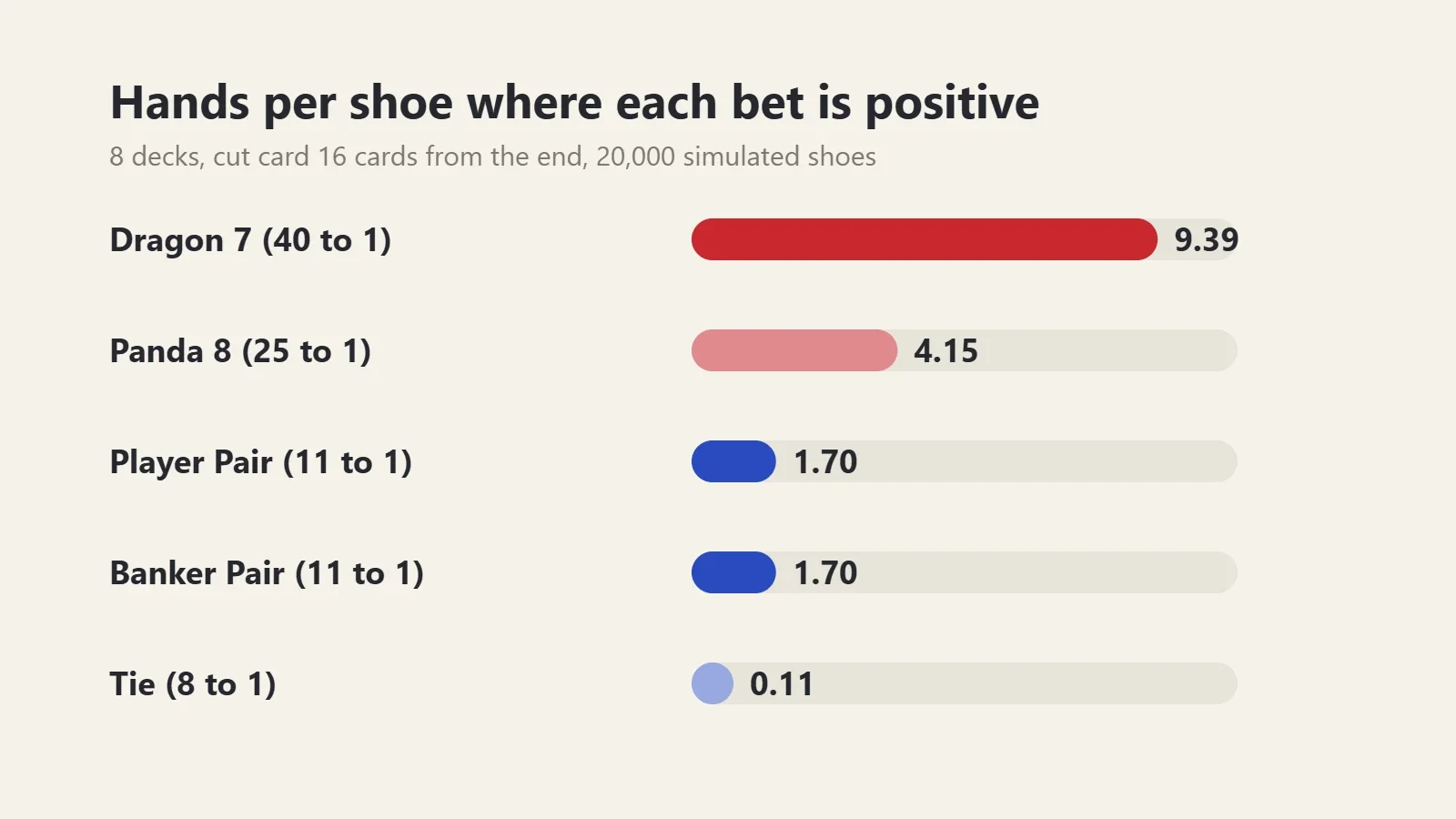
| Fresh-shoe house edge | Positive hands per shoe | Shoes with at least one | Positive hands per shoe, cut one deck early | |
|---|---|---|---|---|
| Dragon 7 (40 to 1) | 7.61% | 9.39 | 72.44% | 6.61 |
| Panda 8 (25 to 1) | 10.19% | 4.15 | 55.67% | 2.29 |
| Player Pair (11 to 1) | 10.36% | 1.70 | 46.74% | 0.40 |
| Banker Pair (11 to 1) | 10.36% | 1.70 | 46.74% | 0.40 |
| Tie (8 to 1) | 14.36% | 0.11 | 6.42% | 0.00 |
Cutting one deck earlier removes a lot of the opportunity. Pairs drop from 1.70 positive hands per shoe to 0.40, and the Tie almost never turns positive at all.
Even at a deep cut card, more than a quarter of shoes never give Dragon 7 a single positive hand.
How deep the cut card sits matters more than any betting idea.
When in the shoe side bets turn positive
Early in a shoe, the remaining cards are close to a full shoe, so every side bet keeps its normal house edge. Dragon 7 was positive on 0.3% of hands 11 to 20, 10.4% of hands 41 to 50 and 34.7% of hands 71 to 80. Panda 8 barely appears before hand 50. The pairs almost only show up after hand 60, and the Tie after hand 70.
Almost every positive moment comes in the last third of the shoe.
Once positive, it rarely lasts. A Dragon 7 run averaged 5.6 hands, but half the runs lasted 2 hands or fewer. Panda 8 averaged 4.2 hands, and the pairs 2.7. About a third of Dragon 7 runs lasted a single hand.
Why a positive side bet still usually loses
When Dragon 7 was positive, its average edge was +7.38%. That still means it wins only about one hand in 40. The bet loses about 97% of the time even at its best. Panda 8 averaged +6.97% and loses about 96% of those hands. The pairs averaged +10.13% and still lose about 9 hands in 10.
A positive expected value is a long-run average. This hand can still lose, and usually does.
That is why the Kelly criterion, which sizes bets by edge and payout, gives tiny fractions here: roughly 0.2% of a bankroll for Dragon 7 at a 7% edge, as a math illustration. It only applies while the bet is positive, it is a long-run average, and the next hand can still lose. Positive moments are rare and short. More on that in the Kelly criterion in baccarat.
At the start of a fresh shoe every bet has a negative expected value. Only the cards left in the shoe can change that, and only briefly. Betting systems can't. Real tables add their own limits too: early cut cards, side bet limits and continuous shufflers all shrink these numbers. For the side bets themselves, see Panda 8 vs Dragon 7 and baccarat pair bets.
See when a side bet turns positive
Baccarator runs the same kind of calculation after each hand you enter.
After each hand you enter the cards and tap Calculate, and Baccarator recalculates the odds and expected value for Banker, Player, Tie, pairs and side bets from the cards still in the shoe. If a bet briefly turns positive, it shows a Kelly sizing suggestion. That only appears when expected value is positive, it is a long-run average, and the next hand can still lose. Positive moments are rare and short. You can choose 6 or 8 decks and practice with virtual chips, with no real money involved.
Baccarat side bets turning positive FAQ
How often do baccarat side bets turn positive?
In our simulation, Dragon 7 was positive on 9.39 hands per shoe, Panda 8 on 4.15, each pair on 1.70 and the Tie on 0.11, with the cut card 16 cards from the end.
When do baccarat side bets become positive?
Almost always in the last third of the shoe. Pairs almost only turned positive after hand 60, and the Tie after hand 70.
Does a positive side bet win most of the time?
No. Even when Dragon 7 was positive it won only about one hand in 40. Positive means a long-run average edge, not a likely win.
Baccarator is a math tool for education. No real-money gambling. 18+ only.
