Pair Bets in Baccarat: Player Pair, Banker Pair and Perfect Pair Math
Two kings land side by side on the player hand. The table murmurs. Somebody's pair bet just paid 11 to 1, and for a moment the bet looks brilliant. Then you remember: it hits 7.47% of the time, and fair odds would be more than 12 to 1. The casino isn't rewarding your luck — it's charging you for the theater.
Pair bets are the most intuitive side bet in baccarat: will the first two cards of a hand match? Here's the complete math — and the deck-count trap that turns a mediocre bet into one of the worst on the felt.
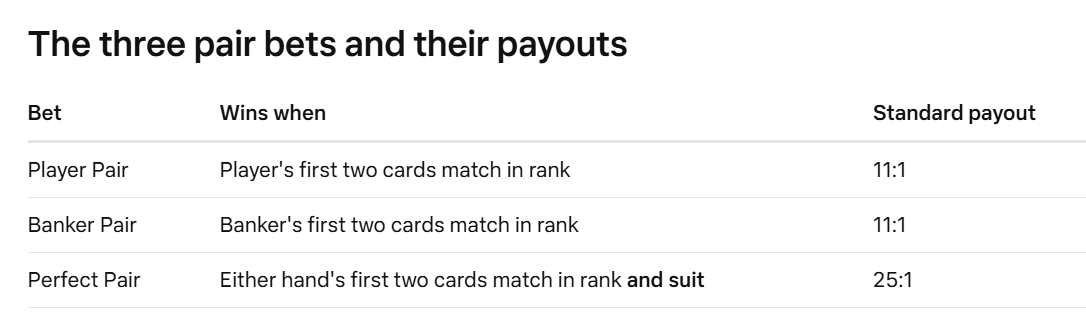
Player Pair and Banker Pair are twins: same probability, same payout, same edge. (Some older tables pay 10:1 — if you see that, walk away. The arithmetic: 0.074699 × 10 − 0.925301 = −0.178311, a 17.83% edge on an eight-deck game. One unit of payout, seven extra points of edge — paytables are everything.) Perfect Pair demands a suited pair — much rarer, much bigger payout — and gets its own full comparison in our Either Pair vs Perfect Pair article.
Probability of a pair from a fresh shoe
Here's the beautiful part: you can count this one by hand. An eight-deck shoe has 416 cards, 32 of each rank.
Total two-card combinations: C(416,2) = 416 × 415 ÷ 2 = 86,320
Pair combinations: 13 ranks × C(32,2) = 13 × 496 = 6,448
P(pair) = 6,448 ÷ 86,320 = 7.4699%
That's roughly one pair in every 13 hands — for each side independently. And the expected value at 11:1:
Pair hits: 0.074699 × 11 = +0.821689
No pair: 0.925301 × 1 = −0.925301
EV = −0.103612 → 10.36% house edge (Wizard of Odds)
The intuition for why 11:1 is a bad price: a 7.47% event has "fair" odds of about 12.4 to 1 (1 ÷ 0.0747 − 1). The casino pays 11. That missing 1.4 units is the 10.36%.
House edge table: standard vs perfect pair
The pair bet is the side bet most sensitive to deck count in all of baccarat (Wizard of Odds):
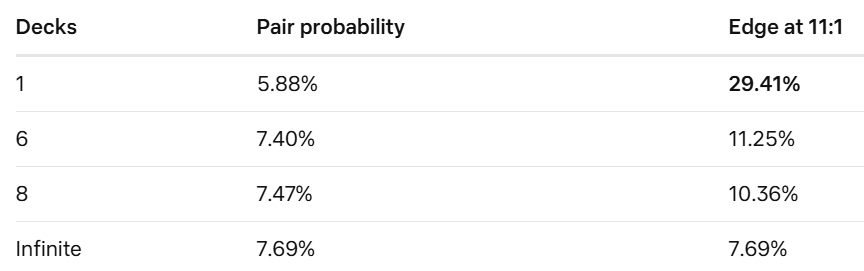
The single-deck row deserves a moment of silence: 29.41% — nearly triple the eight-deck edge, for the identical bet at the identical payout. With one deck, each dealt card wipes out a quarter of its rank's remaining copies (3 of 51 vs. 32 of 416), so pairs dry up fast while the payout stays frozen at 11:1.
Two paytable footnotes worth knowing: some casinos pay 12:1 on pairs (Fallsview in Niagara Falls was reported to), which cuts the eight-deck edge to about 2.89% — genuinely playable. And Perfect Pair's 25:1 suited paytable runs roughly 13–17% depending on decks — the full shootout is in our Either Pair vs Perfect Pair comparison.
Why pairs cluster late in the shoe
Players swear pairs come in bunches near the end of the shoe. There's a real mechanism behind the feeling — not a pattern, just composition math.
Early in the shoe, ranks are evenly distributed: 32 of each, and removing a few cards barely dents any rank's share. But deep in the shoe, discards are never perfectly balanced. Suppose late in an eight-deck shoe, most ranks are down to 8–10 copies while kings still have 20 left. The next two cards are now disproportionately likely to both be kings — the shoe is rank-lopsided, and lopsided shoes make pairs.
The honest framing: pairs don't "cluster" because the shoe remembers. They cluster because late shoes are often uneven, and unevenness favors matching. A calculator watching the remaining rank counts can see the pair probability tick up in real time — no mysticism, just hypergeometric arithmetic on the cards left.
Worked example: why one deck is a mugging
The 29.41% single-deck edge deserves its full arithmetic, because it's the most dramatic deck-count effect in baccarat:
With one deck, the second card matches the first's rank with probability 3/51 = 5.8824% (three matching cards left out of 51).
EV at 11:1: 0.058824 × 11 − 0.941176 × 1 = 0.647059 − 0.941176 = −0.294118 → 29.41%
Every $100 on a single-deck pair bet costs $29.41 — nearly triple the eight-deck price of $10.36, for the identical payout. The mechanism is pure dilution: with eight decks, each dealt card barely dents its rank's remaining share (31 of 415 left); with one deck, it guts it (2 of 50 left). Same 11:1 payout, far fewer possible pairs. If a casino ever offers you single-deck baccarat with pair bets, it's not being generous with the single deck — it's being generous with itself.
Tracking pairs live: what to actually watch
If you want to play pair bets intelligently — or at least less unintelligently — watch the rank distribution, not the bead road. The pair probability on the next hand is pure hypergeometric math on the remaining cards:
Many ranks depleted, a few ranks heavy → pair probability rises. Example: late in the shoe, if kings still have 20 copies left while most ranks are down to single digits, the next two cards are disproportionately likely to both be kings.
Even depletion across ranks → pair probability sits near the fresh-shoe baseline (~7.47% on 8 decks).
One rank nearly exhausted → that rank contributes almost no pairs, dragging the total down slightly.
A real-time calculator does this counting for you: after every hand, it recomputes each rank's remaining count and updates the pair probability. The honest use isn't finding a +EV moment (those are vanishingly rare on pair bets) — it's knowing when the bet is at its least bad, and more importantly, recognizing that the "pair streak" you think you see is just composition doing its thing.
FAQ
1. Are Player Pair and Banker Pair really identical?
Mathematically, yes — same 7.47% probability, same 11:1 payout, same 10.36% edge on eight decks. Any difference you think you observe is variance plus selective memory.
2. Can both Player Pair and Banker Pair hit on the same hand?
Yes — the two hands are dealt independently, so both can pair simultaneously (about 0.56% of hands on eight decks: 0.0747 × 0.0747). Betting both doesn't change either bet's edge; it just doubles your action at the same bad price.
3. What's the cheapest pair bet available?
The standard 11:1 Player/Banker Pair at eight decks (10.36%). Either Pair (5:1) runs ~13.7–14.5% and Perfect Pair (25:1) ~13–17% depending on decks — the full comparison is in our Either Pair vs Perfect Pair article. And if you ever find the rumored 12:1 pair paytable, that's ~2.89% — take it.
Pair bets are honest entertainment at 10.36% — expensive, transparent, and occasionally thrilling. Just never play them on a single-deck table, always confirm the 11:1 (not 10:1) payout, and remember that the "hot pair streak" is composition, not destiny.
Watch pair probabilities update live as the shoe depletes — Baccarator recomputes every side bet after each hand. Free on the App Store. Stop guessing, start calculating.
