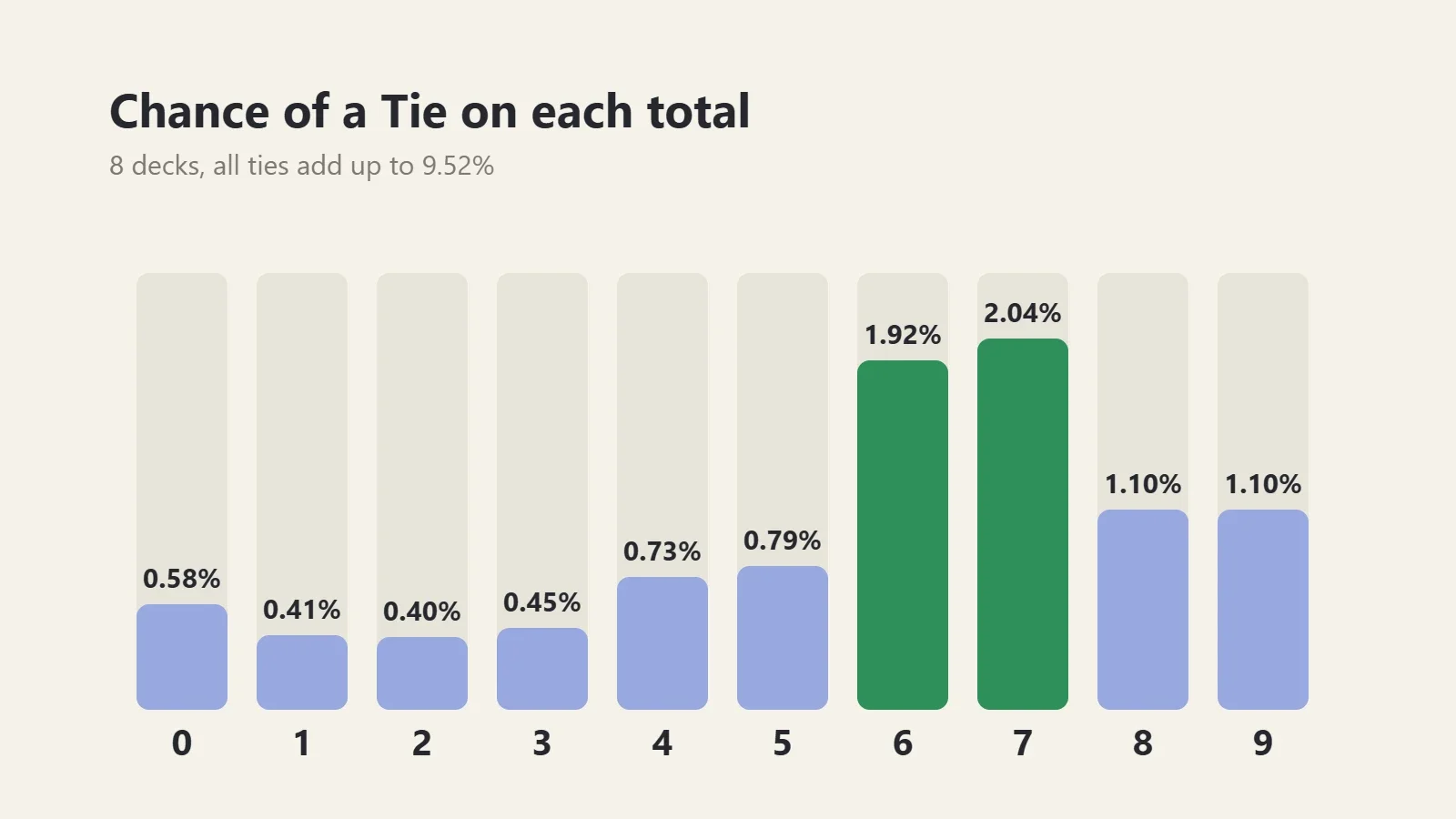
Not all baccarat ties are equally likely. A tie on 7 happens on 2.04% of hands and a tie on 6 on 1.92%, while ties on 1, 2 or 3 each happen only about 0.4% of the time. Together, all ten totals add up to the familiar 9.52% Tie rate for an 8-deck shoe.
Some tables offer bets on a tie with a specific total. The table below gives the fair payout for each one, so you can check any paytable yourself.
Probability of a tie on each total
We counted every possible card order in a fresh 8-deck shoe and split the ties by the total both hands ended on. The fair payout is the payout at which the bet would break even.
| Probability | Fair payout (to 1) | |
|---|---|---|
| Tie on 0 | 0.58% | 171.5 |
| Tie on 1 | 0.41% | 242.8 |
| Tie on 2 | 0.40% | 248.8 |
| Tie on 3 | 0.45% | 223.6 |
| Tie on 4 | 0.73% | 136.7 |
| Tie on 5 | 0.79% | 125.0 |
| Tie on 6 | 1.92% | 51.0 |
| Tie on 7 | 2.04% | 48.1 |
| Tie on 8 | 1.10% | 90.1 |
| Tie on 9 | 1.10% | 89.6 |
| Any Tie | 9.52% | 9.5 |
Ties on 6 and 7 make up about 42% of all ties. Both hands stand on 6 or 7 under the drawing rules, so these totals often freeze in place and meet each other.
Ties cluster on 6 and 7 because both sides stand on those totals.
Ties on 8 and 9 come mostly from naturals on both sides. Ties on 1, 2 and 3 are rare because a hand usually draws away from those totals.
How to check a tie-on-a-number paytable
Payouts for these bets differ from table to table, so instead of assuming one paytable, use the fair payout column. If the posted payout is lower than fair, the bet has a house edge. The formula is house edge = 1 − probability × (payout + 1).
For example, a tie on 6 paying 35 to 1 has a house edge of 30.74%, since its fair payout is 51 to 1. That bet is covered in baccarat Tiger bets. The ordinary Tie bet at 8 to 1 costs 14.36%, explained in tie bet odds and house edge.
The rarer the tie, the larger the payout needs to be just to break even.
At the start of a fresh shoe every bet has a negative expected value. Only the cards left in the shoe can change that, and only briefly. Betting systems can't.
Ties on 6 and 7 together happen on about 4% of hands, more than all ties on 0 to 5 combined.
See the Tie odds move with the shoe
Tie odds react to the remaining cards more than Banker or Player do.
After each hand you enter the cards and tap Calculate, and Baccarator recalculates the odds and expected value for Banker, Player, Tie, pairs and side bets from the cards still in the shoe. If a bet briefly turns positive, it shows a Kelly sizing suggestion. That only appears when expected value is positive, it is a long-run average, and the next hand can still lose. Positive moments are rare and short. You can choose 6 or 8 decks and practice with virtual chips, with no real money involved.
Baccarat tie by total FAQ
What is the most common tie in baccarat?
A tie on 7, at 2.04% of hands, followed closely by a tie on 6 at 1.92%.
What are the odds of a tie on 0 in baccarat?
About 0.58% of hands with 8 decks, so the fair payout is about 171.5 to 1.
How do I work out the house edge on a tie-by-total bet?
Use house edge = 1 − probability × (payout + 1). A tie on 6 at 35 to 1 gives 30.74%.
Baccarator is a math tool for education. No real-money gambling. 21+ only.
