Baccarat Third Card Rules Explained (With Chart)
Baccarat's third card rules decide whether Player or Banker gets one more card after the first two. If either side has 8 or 9 on its first two cards, that's a natural and nobody draws. Otherwise Player draws on 0 to 5 and stands on 6 or 7. Banker's rule depends on Banker's own total and on the third card Player just drew, which is why it needs a table.
The full chart is below, and you can save it. After that I'll show you, with exact numbers, how much that one table is worth to the Banker side.
A quick note on counting first. In baccarat, 10s and face cards are worth 0, Aces are worth 1, and you only keep the last digit of the total. A 7 and an 8 make 15, so the hand is a 5.
When nobody draws in baccarat (naturals)
Both sides get two cards. If either one totals 8 or 9, the hand is over right there. That's called a natural.
It doesn't matter what the other side has. If Player shows a natural 8 and Banker has 7, Banker doesn't get to draw for a chance at 9. Higher total wins, and two naturals of the same value are a Tie.
Naturals happen a lot more than people expect. In an 8-deck shoe, about one hand in three ends on a natural.
Player third card rule: draw on 0 to 5, stand on 6 or 7
If there's no natural, Player goes first, and Player's rule is short.
Player has 0 to 5, Player draws one card. Player has 6 or 7, Player stands.
That's all. Player's rule never looks at Banker's cards. Whatever Banker is holding, Player plays the same way.
Banker third card rules chart
Banker goes second, and Banker's rule has two cases.
If Player stood, Banker plays just like Player did. Draw on 0 to 5, stand on 6 or 7.
If Player drew a third card, Banker looks at two things, Banker's own total and the value of that third card. This is the part everyone has to look up.
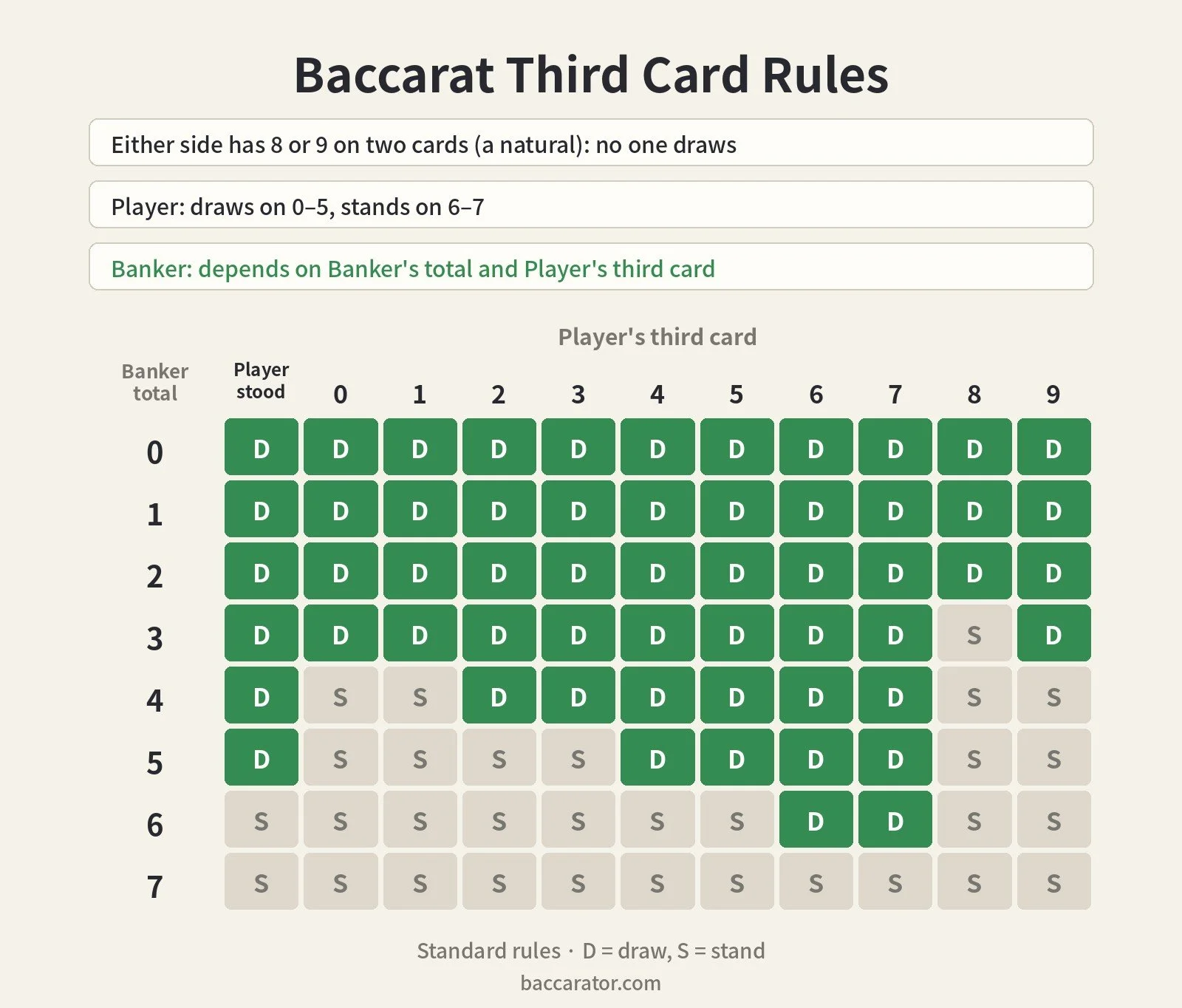
Here's the same chart as a table.
| If Player stood | If Player drew a third card | |
|---|---|---|
| Banker 0, 1, 2 | Draw | Draw |
| Banker 3 | Draw | Draw, unless Player's third card is 8 |
| Banker 4 | Draw | Draw if Player's third card is 2 to 7 |
| Banker 5 | Draw | Draw if Player's third card is 4 to 7 |
| Banker 6 | Stand | Draw if Player's third card is 6 or 7 |
| Banker 7 | Stand | Stand |
| Banker 8, 9 | Natural, no one draws | |
Take Banker 5 as an example. If Player stood, Banker draws. If Player drew a 4, 5, 6 or 7, Banker draws. Any other third card, Banker stands.
Why the Banker's third card rules are more complicated
Because Banker acts second, and gets to see something Player never does.
Here's a hand. Player has 3 and 2, a total of 5, so Player draws. The third card is a 6, and Player's total drops to 1. Banker has a King and a 5, also a total of 5.
Banker now checks the chart. Banker 5, Player's third card 6, so Banker draws.
Notice what just happened. Banker's decision was made after seeing Player's third card. Player's decision was made blind.
Nobody at the table chooses any of this, by the way. The dealer follows the chart on every hand. But the chart itself was written to use that extra bit of information, and that's where Banker's small edge comes from.
How the third card rules change Banker, Player and Tie odds
I ran every possible deal through the rules for a full 8-deck shoe. First, how often each situation happens.
| Share of hands | |
|---|---|
| Natural 8 or 9, no one draws | 34.30% |
| No natural, both stand | 3.58% |
| Only Player draws | 18.57% |
| Only Banker draws | 11.77% |
| Both draw | 31.77% |
Add it up and Player draws a third card in 50.34% of hands, Banker in 43.54%.
Now the interesting part. What if Banker didn't have a chart, and simply followed Player's rule, draw on 0 to 5 and stand on 6 or 7?
| Standard rules | If Banker used Player's rule | |
|---|---|---|
| Banker wins | 45.86% | 45.31% |
| Player wins | 44.62% | 45.31% |
| Tie | 9.52% | 9.38% |
With the same rule on both sides, the game is perfectly even. All of Banker's edge over Player comes from that one table.
That's also why Banker wins pay 95% after a 5% commission. With the commission, the house edge is 1.06% on Banker and 1.24% on Player. I went through where those numbers come from in another post.
None of this tells you what the next hand will be. These are long-run percentages, and any single hand can go either way. The odds also shift a little as cards leave the shoe, which I covered here.
Let Baccarator handle the third card rules for you
Baccarator is free on the App Store. Every Banker, Player and Tie number it shows already has the third card rules built in, so you never have to check the chart yourself. Enter the cards as they're dealt, and it recalculates after every card. You can practice with virtual points, and no real money is involved.
Download Baccarator free|https://apps.apple.com/app/id6740475592
Baccarat third card rules FAQ
1. When does the Banker draw a third card in baccarat?
If Player stood, Banker draws on 0 to 5 and stands on 6 or 7. If Player drew a third card, it depends on Banker's total and that card. Banker always draws on 0 to 2, never draws on 7, and follows the chart for 3 to 6.
2. Does Player draw on 6 in baccarat?
No. Player draws on 0 to 5 and stands on 6 or 7. Player's rule doesn't depend on Banker's cards.
3. Are baccarat third card rules the same everywhere?
Almost all standard baccarat uses these same rules. Variations like no-commission baccarat usually change how bets pay, not when cards are drawn. All numbers in this post use the standard rules.
Baccarator is a math tool for education. No real-money gambling. 21+ only.
