You lose at baccarat mostly because of a small edge repeated many times. Banker gives up 1.06% per hand and Player 1.24%, which sounds like nothing, but it never stops. Betting Banker every hand, your chance of being ahead is 44.74% after 100 hands, 35.76% after 1,000, and only 12.69% after 10,000.
If you have been losing and thought it was bad luck or bad reading of the board, that is a very normal thing to think. The numbers below explain what is actually going on.
The house edge adds up hand after hand
Banker wins 45.86% of hands, but a Banker win pays 0.95 after commission. Player wins 44.62% and pays 1 to 1. Either way the average result of each bet is slightly negative. The full calculation is in baccarat house edge.
One hand of 1 unit costs about 0.01 units on average. A thousand hands cost about 10.6 units. Nothing dramatic happens on any single hand. The cost just keeps arriving.
A 1% edge is invisible in one hand and decisive over a thousand.
Why longer sessions make losing more likely
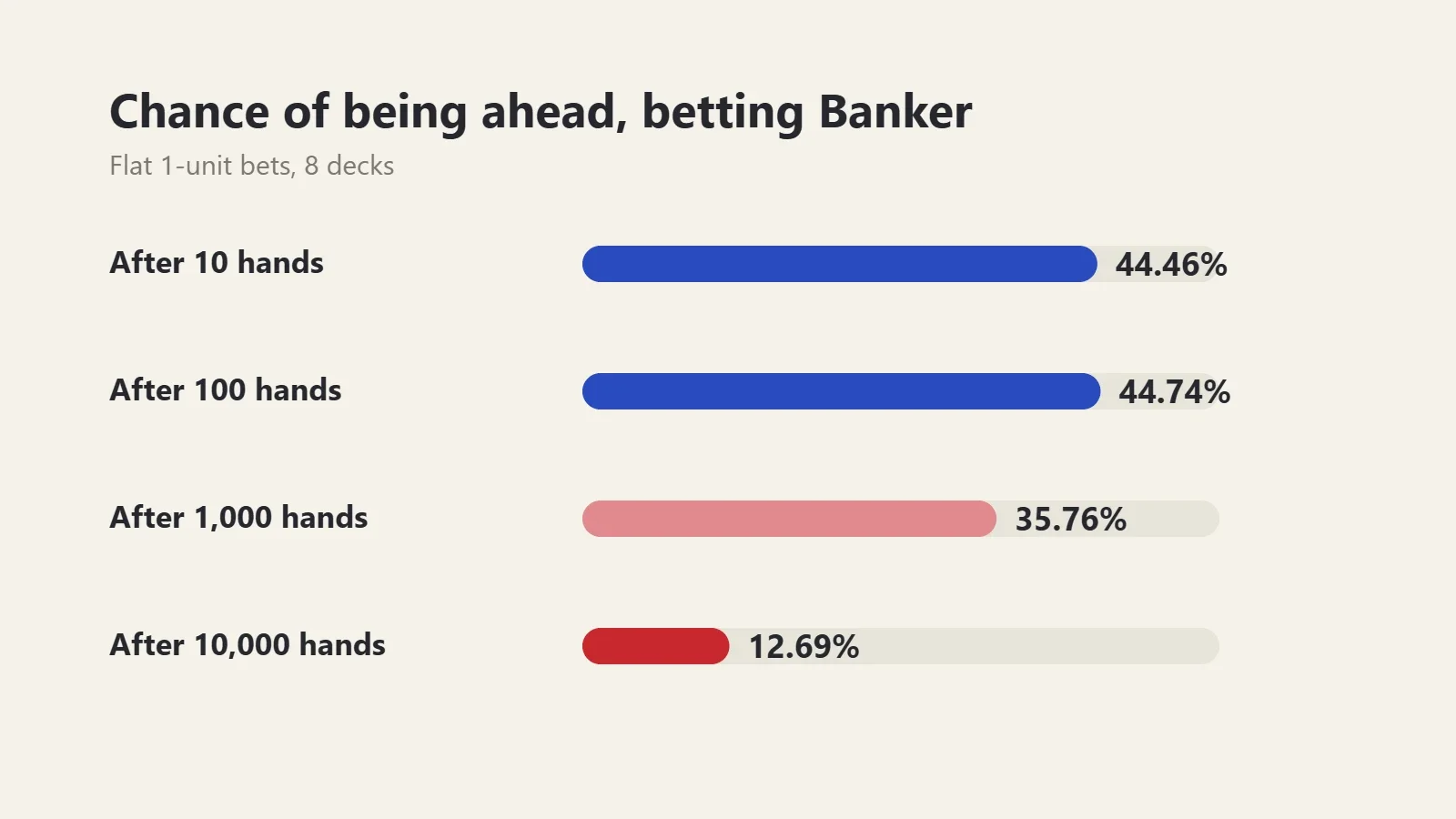
| Chance of being ahead | Average loss (units) | |
|---|---|---|
| 10 hands | 44.46% | 0.11 |
| 100 hands | 44.74% | 1.06 |
| 1,000 hands | 35.76% | 10.58 |
| 10,000 hands | 12.69% | 105.80 |
In a short session, luck swamps the edge. After 10 or 100 hands you are ahead almost as often as a coin flip would suggest. That is exactly why baccarat feels beatable: plenty of nights end in profit.
Stretch it out and the edge takes over. The swings grow with the square root of the number of hands, while the expected loss grows in a straight line. By 10,000 hands, only about one player in eight is still ahead.
Short sessions feel winnable because they often are. Long-run results are a different story.
Side bets and betting systems speed up losses
Side bets carry much bigger edges. The Tie at 8 to 1 costs 14.36%, and Super 6 at 12 to 1 costs 29.98%. A few side bets per shoe can cost more than all the main bets combined. The comparison is in expected value of baccarat side bets.
Betting systems don't change the edge either. Raising bets after a loss, as in Martingale, puts more money in play exactly when you are down, so the losses that do come are larger. See baccarat betting systems for how each one works out.
At the start of a fresh shoe every bet has a negative expected value. Only the remaining cards can change that, and only briefly. Betting systems can't, and patterns on the scoreboard can't.
If losing has started to hurt
If you notice you are chasing losses, playing longer than you planned, or spending money you need, those are signs to step back. Talking to someone you trust, or a local problem gambling helpline, matters more than any number in this post.
See the math without risking money
If you want to understand the game rather than chase it, Baccarator lets you follow a shoe with virtual chips only.
After each hand you enter the cards and tap Calculate, and Baccarator recalculates the odds and expected value for Banker, Player, Tie, pairs and side bets from the cards still in the shoe. If a bet briefly turns positive, it shows a Kelly sizing suggestion. That only appears when expected value is positive, it is a long-run average, and the next hand can still lose. Positive moments are rare and short. You can choose 6 or 8 decks and practice with virtual chips, with no real money involved.
Why you lose at baccarat FAQ
Why do I keep losing at baccarat?
Mostly the house edge, 1.06% on Banker and 1.24% on Player, repeated over many hands, plus normal swings. Side bets and progressive betting systems make losses bigger.
Is baccarat 50/50?
Close, but not quite. Leaving Ties out, Banker wins 50.68% of decided hands, and the 5% commission turns that into a small loss on average.
Can you win at baccarat in the long run?
Not with Banker or Player bets over a long run. Betting Banker for 10,000 hands, only about 12.69% of players end up ahead.
Baccarator is a math tool for education. No real-money gambling. 21+ only.
