After a tie in baccarat, the next hand plays out almost exactly like any other hand. In 2 million simulated 8-deck shoes, the hand right after a tie went Banker 45.89%, Player 44.61% and Tie 9.51%. The usual odds are 45.86%, 44.62% and 9.52%. The gap is a few hundredths of a percentage point.
So there is no side that "comes after a tie." Here is how we checked, and why the result makes sense.
Banker, Player and Tie odds after a tie
A tie means both hands ended on the same total. Your Banker or Player bet is returned, and the next hand is dealt from the same shoe. We dealt 2 million shoes with a cut card 16 cards from the end, about 160 million hands, and looked at the hand that followed each tie. That gave about 15 million hands after a tie.
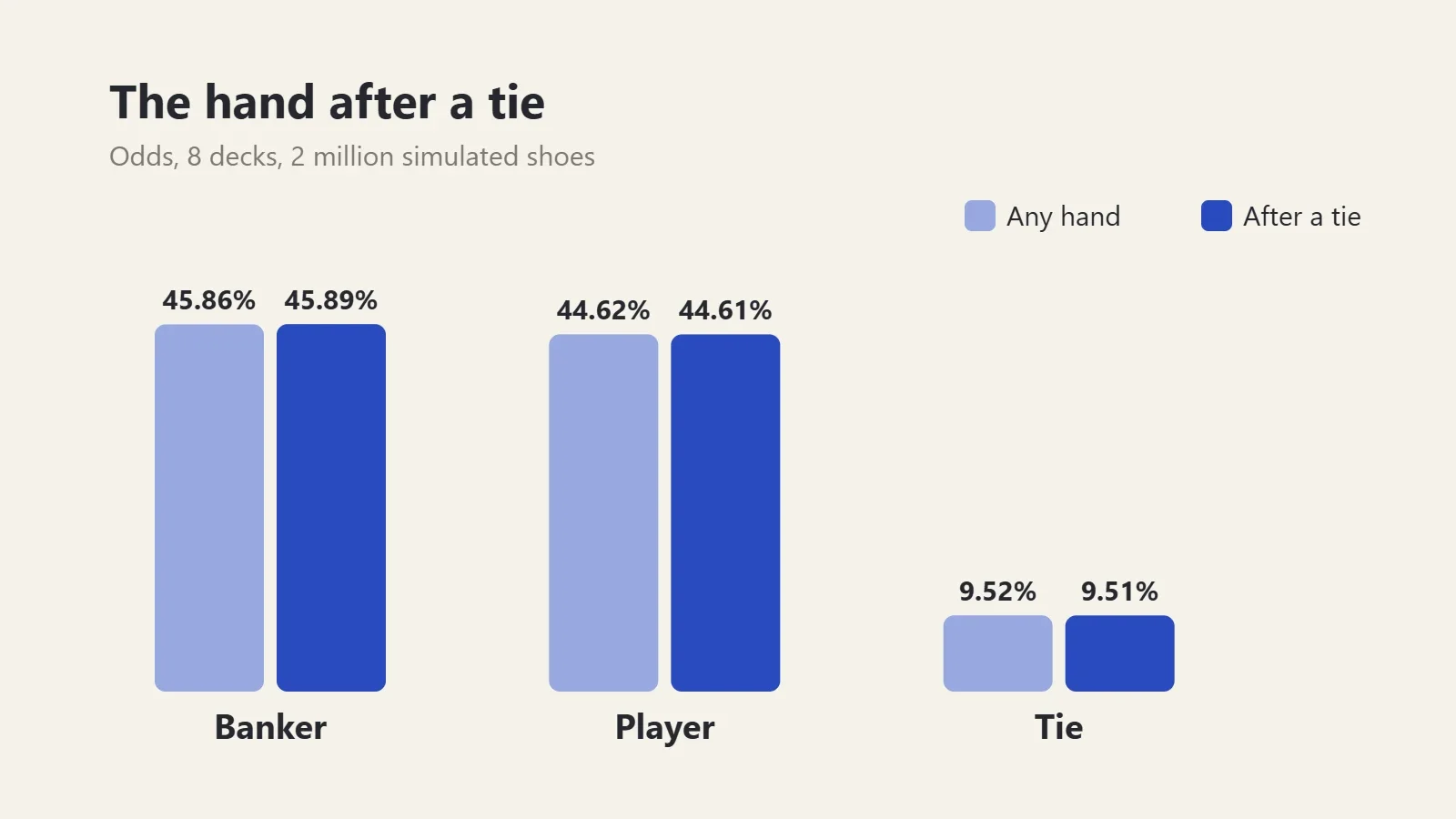
| Banker | Player | Tie | |
|---|---|---|---|
| Any hand | 45.86% | 44.62% | 9.52% |
| Hand right after a tie | 45.89% | 44.61% | 9.51% |
| Hand after two ties in a row | 45.91% | 44.58% | 9.52% |
In our data, the odds after a tie stayed within 0.03 percentage points of normal.
Even two ties in a row changes nothing you could use. That sample is smaller, about 1.4 million hands, so its last digit is less certain, but it sits right on top of the normal odds.
The hand after a tie is just another hand from the same shoe.
Why a tie does not change the next hand
The next hand only depends on the cards still in the shoe. A tie uses four to six cards, the same as any other hand, and those cards are a mix of values. Taking out one mix of cards instead of another moves the odds by a tiny amount, which is what the table shows.
Our post on which cards help Banker or Player shows the scale. Even removing four cards of the same value shifts Banker's house edge by less than 0.05 percentage points.
A tie tells you which cards left the shoe, not which side is due.
If you want the real reason a result feels "due," it is the scoreboard. A row of ties looks meaningful on paper. The cards don't keep track of it. Our baccarat patterns post covers this in more detail.
What a tie means for your bet
On a standard table, a tie returns your Banker and Player bets. You don't win or lose. Only a Tie bet pays, usually 8 to 1, which costs about 14.36% over time. The details are in tie bet odds and house edge.
Betting Banker or Player after a tie costs the same as betting them on any other hand.
At the start of a fresh shoe every bet has a negative expected value. Only the cards left in the shoe can change that, and only briefly. Following ties is a betting system, and betting systems can't.
Check the odds after a tie yourself
If you want to see this hand by hand, a tracker that counts the remaining cards shows how little a tie changes.
After each hand you enter the cards and tap Calculate, and Baccarator recalculates the odds and expected value for Banker, Player, Tie, pairs and side bets from the cards still in the shoe. If a bet briefly turns positive, it shows a Kelly sizing suggestion. That only appears when expected value is positive, it is a long-run average, and the next hand can still lose. Positive moments are rare and short. You can choose 6 or 8 decks and practice with virtual chips, with no real money involved.
Baccarat after a tie FAQ
What happens after a tie in baccarat?
The next hand is dealt from the same shoe with almost the same odds: Banker 45.89%, Player 44.61%, Tie 9.51% in our simulation, against 45.86%, 44.62% and 9.52% for any hand.
Should you bet Banker or Player after a tie?
A tie doesn't make either side more likely. Banker still has the lower house edge, 1.06% against 1.24% for Player.
Are ties more likely after a tie?
No. In our data the hand after a tie was a tie 9.51% of the time, the same as any hand.
Baccarator is a math tool for education. No real-money gambling. 18+ only.
