A baccarat hand uses 4, 5 or 6 cards. Each side gets two, and each can draw one more. With 8 decks, 37.89% of hands end with 4 cards, 30.34% with 5 and 31.77% with 6. On average a hand uses 4.94 cards. Player draws a third card 50.34% of the time and Banker 43.54%.
Who wins depends a lot on how the hand ended. When only one side draws, the side that stood wins about three times out of four.
Baccarat hand odds by number of cards
We calculated every possible deal from a fresh 8-deck shoe, card by card, and sorted hands by how they finished.
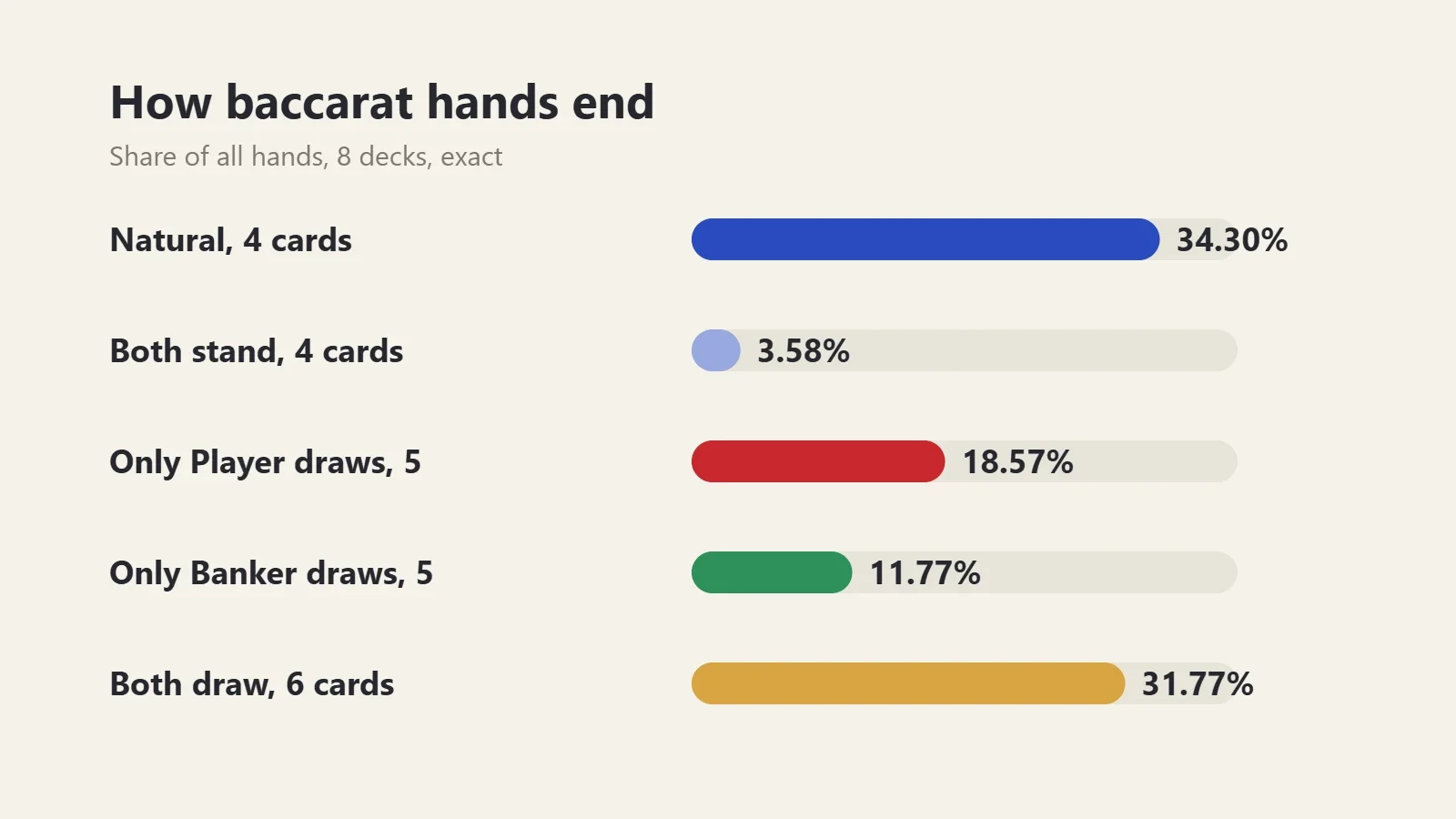
| Cards | Share of hands | Banker wins | Player wins | Tie | |
|---|---|---|---|---|---|
| A natural (8 or 9) | 4 | 34.30% | 47.40% | 47.40% | 5.21% |
| Both stand on 6 or 7 | 4 | 3.58% | 25.05% | 25.05% | 49.89% |
| Only Player draws | 5 | 18.57% | 72.26% | 18.24% | 9.50% |
| Only Banker draws | 5 | 11.77% | 19.22% | 73.10% | 7.68% |
| Both draw | 6 | 31.77% | 40.99% | 48.71% | 10.30% |
Four-card hands split into two kinds. Naturals, where someone has 8 or 9 on two cards, are 34.30% of all hands, and Banker and Player win them equally. The rare case where both sides stand on 6 or 7 ends in a tie almost half the time, because the only possible results are 6 against 7 or a match.
Two-card naturals are a coin flip between Banker and Player.
Why the side that stands usually wins
When only Player draws, Banker stood. Banker only stands in those spots when its total is already strong compared with what Player is likely to end up with, so Banker wins 72.26% of those hands. When only Banker draws, it is because Player stood on 6 or 7 and Banker had 5 or less, and Player wins 73.10%.
When only one side draws, the side that stood wins about three hands out of four.
Six-card hands, where both sides draw, lean the other way: Player wins 48.71% and Banker 40.99%. Across all hands it evens out to Banker 45.86% and Player 44.62%. The full drawing rules are in baccarat third card rules, and the reason Banker comes out ahead is in why Banker has an edge.
Banker loses more of the hands where both sides draw, and wins it back when Player draws alone.
What this means at the table
None of this changes your decision, because nobody chooses whether to draw in standard baccarat. The rules decide. It is still useful for one thing: when you see Player take a third card and Banker stand, you are watching the situation Banker wins most often.
Player taking a third card while Banker stands is Banker's best spot in the game.
Ties follow the same logic. They are rarest when someone has a natural, 5.21% of those hands, and most common when both sides stand on 6 or 7.
At the start of a fresh shoe every bet has a negative expected value. Only the cards left in the shoe can change that, and only briefly. Betting systems can't. For the two-card totals behind all this, see baccarat card values.
Follow every hand with the real odds
Each hand's odds depend on which cards are left, and that changes after every deal.
After each hand you enter the cards and tap Calculate, and Baccarator recalculates the odds and expected value for Banker, Player, Tie, pairs and side bets from the cards still in the shoe. If a bet briefly turns positive, it shows a Kelly sizing suggestion. That only appears when expected value is positive, it is a long-run average, and the next hand can still lose. Positive moments are rare and short. You can choose 6 or 8 decks and practice with virtual chips, with no real money involved.
Baccarat cards per hand FAQ
How many cards are dealt in a baccarat hand?
Four, five or six. Each side gets two cards and may draw a third. The average is 4.94 cards.
How often does Player draw a third card in baccarat?
50.34% of hands with 8 decks. Banker draws a third card 43.54% of the time.
Who wins more often when both sides draw?
Player, 48.71% against 40.99% for Banker, with ties the rest.
Baccarator is a math tool for education. No real-money gambling. 18+ only.
