A stop-loss or win goal doesn't change the odds in baccarat. It changes the shape of your results, not the average. Set a small win goal and a big stop-loss, say win 5 units or lose 20, and you reach the goal 73.46% of the time. But the rare losses are four times larger, and the average session still ends about 1.44 units down.
Limits are still useful for something else, which we'll get to. First, the numbers.
How we calculated stop-loss and win goal odds
Each session bets a flat 1 unit on Banker every hand. A win pays 0.95, a loss costs 1, and a Tie pushes. The session ends the moment you are up by the win goal or down by the stop-loss. We solved this exactly for an 8-deck shoe, no simulation noise.
Chance of reaching the win goal first
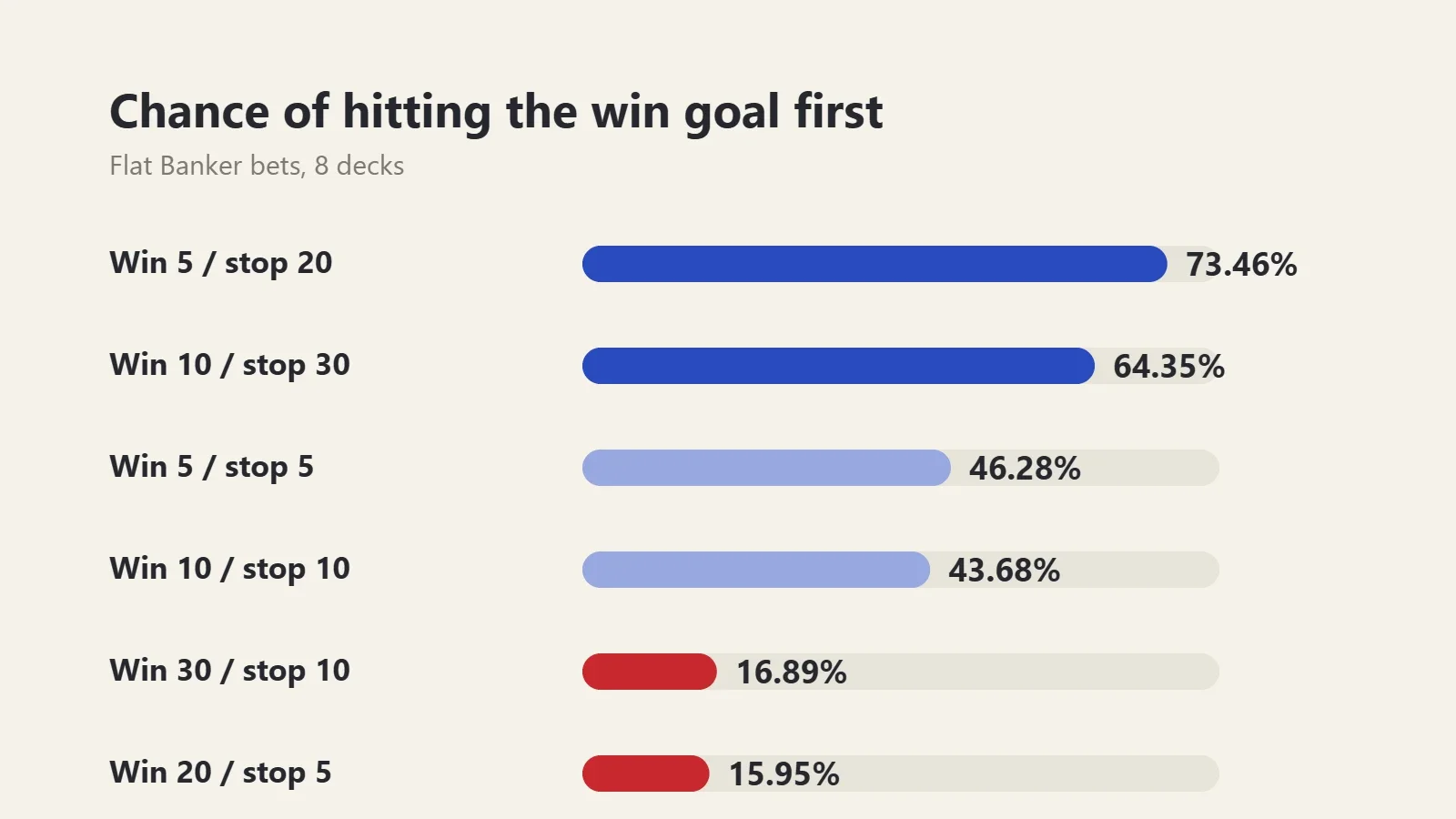
| Win goal | Stop-loss | Chance of reaching the goal | Average hands | Average result (units) | |
|---|---|---|---|---|---|
| Setting A | +5 | −5 | 46.28% | 34 | −0.36 |
| Setting B | +10 | −10 | 43.68% | 126 | −1.33 |
| Setting C | +5 | −20 | 73.46% | 136 | −1.44 |
| Setting D | +20 | −5 | 15.95% | 119 | −1.26 |
| Setting E | +10 | −30 | 64.35% | 392 | −4.15 |
| Setting F | +30 | −10 | 16.89% | 334 | −3.53 |
Notice the even setting, win 10 or lose 10. In a fair coin game you would hit the goal half the time. With Banker you get there only 43.68% of the time, because each win pays 0.95, so you need about 11 net wins to gain 10 units but only 10 net losses to lose 10.
Moving the limits trades how often you win for how much you lose when you don't. The average stays negative.
Why the average result never turns positive
Every hand you play costs about 1.06% of the bet on average. Limits only decide how many hands you play. That is why the average result in the table is almost exactly 1.06% of the average number of hands: about 126 hands costs about 1.33 units, about 392 hands costs about 4.15.
Small win goals feel great because they work most of the time. The cost hides in the occasional session that runs all the way to the stop-loss.
A 73% chance of a small win is not the same as a winning plan.
At the start of a fresh shoe every bet has a negative expected value, and betting systems can't change that. The same goes for progressions; see baccarat betting systems.
Limits decide how many hands you play. The house edge decides what each hand costs.
What limits are actually good for
A stop-loss caps how bad one night can get, and a time limit caps how many hands you play. Fewer hands means less expected loss. That is a real benefit, it just isn't an edge. If you find yourself moving the stop-loss once you hit it, that is a sign to step away and maybe talk to someone.
Practice the numbers with virtual chips
If you want to see how often a goal gets hit in practice, try it with virtual chips first.
After each hand you enter the cards and tap Calculate, and Baccarator recalculates the odds and expected value for Banker, Player, Tie, pairs and side bets from the cards still in the shoe. If a bet briefly turns positive, it shows a Kelly sizing suggestion. That only appears when expected value is positive, it is a long-run average, and the next hand can still lose. Positive moments are rare and short. You can choose 6 or 8 decks and practice with virtual chips, with no real money involved.
Baccarat stop-loss FAQ
Does a stop-loss help in baccarat?
It limits how much one session can lose, but it doesn't change the 1.06% house edge on Banker. The average result stays negative.
What is a good win goal in baccarat?
There is no win goal that makes the average positive. A small goal is reached more often, for example 73.46% for win 5 or lose 20, but the losses are larger.
Should I stop when I'm ahead in baccarat?
Stopping early means fewer hands and less expected loss. It doesn't make the next session any more likely to win.
Baccarator is a math tool for education. No real-money gambling. 21+ only.
