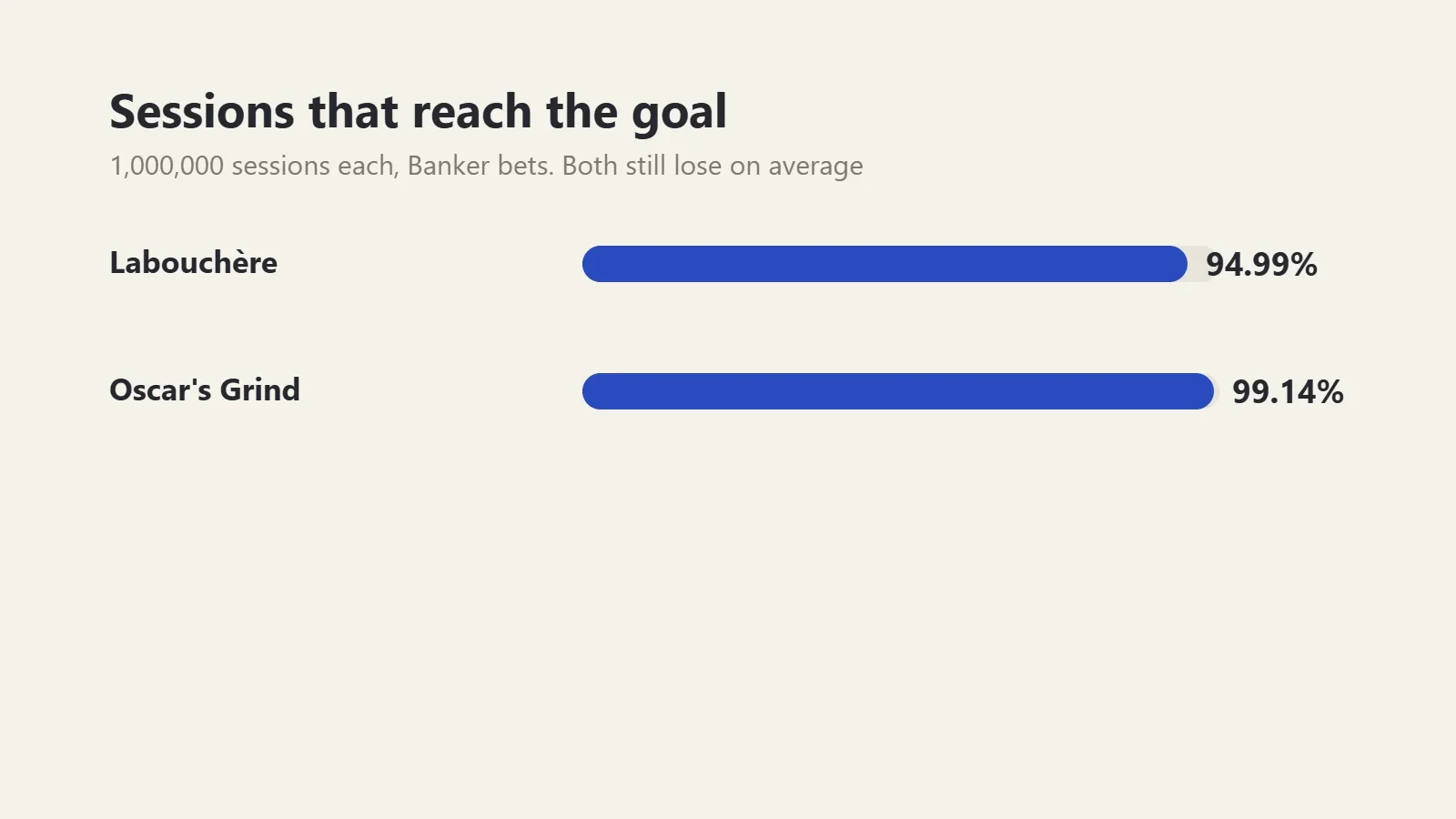
Labouchère and Oscar's Grind both win most sessions in baccarat and still lose money on average. Betting Banker with a 200-unit bankroll, Labouchère reached its goal in 94.99% of a million simulated sessions and Oscar's Grind in 99.14%. But the sessions that failed cost about 170 to 190 units each, enough to wipe out all the small wins and then some.
Here is how each system works and what the simulation showed.
How Labouchère and Oscar's Grind work
Labouchère starts with a list of numbers, here 1, 2, 3, 4. Each bet is the first number plus the last. A win crosses both off; a loss adds the lost amount to the end of the list. When the list is empty, the session is done, up about 10 units minus commission.
Oscar's Grind aims for just 1 unit per series. Start with 1 unit. After a loss, keep the same bet. After a win, raise it by 1, but never bet more than you need to finish the series 1 unit up.
Both feel gentle compared with Martingale, which doubles after every loss. Our earlier tests of Fibonacci, Paroli, 1-3-2-6 and others are in baccarat betting systems.
Labouchère and Oscar's Grind results from 1 million sessions
Each session bets Banker, starts with 200 units, and ends when the goal is reached, the next bet can't be covered, or 2,000 hands pass.
| Labouchère (1-2-3-4) | Oscar's Grind (+1 unit) | |
|---|---|---|
| Sessions that reach the goal | 94.99% | 99.14% |
| Average profit when it works | +8.02 units | +1.28 units |
| Average loss when it fails | −170.55 units | −187.15 units |
| Average result per session | −0.93 units | −0.35 units |
| Average total wagered per session | 93.6 units | 31.3 units |
Labouchère's wins average about 8 units, not 10, because the 5% commission trims every Banker win. Oscar's Grind wins average about 1.3 units because rounding the bet up sometimes overshoots the target.
Winning 99 sessions out of 100 means nothing if the 100th costs 187 units.
Why both systems still lose
Look at the last two rows of the table. The average loss per session is close to 1% of the total amount wagered, which is just the house edge on Banker. The systems decide when bets get bigger, but every unit wagered still carries the same 1.06% cost.
What they change is the shape of the results. Most sessions end slightly ahead, which feels like the system works. A few sessions run into a long losing streak, the bets climb, and the bankroll runs out. In 3.19% of Labouchère sessions, a single bet reached 50 units or more.
Betting systems move losses into rare, large sessions. They don't remove them.
At the start of a fresh shoe every bet has a negative expected value. Only the remaining cards can change that, and only briefly. Betting systems can't.
A system can make most sessions end slightly ahead. It can't make the average positive.
Test a system with virtual chips first
If you want to see a system's swings for yourself, try it with virtual chips before anything else.
After each hand you enter the cards and tap Calculate, and Baccarator recalculates the odds and expected value for Banker, Player, Tie, pairs and side bets from the cards still in the shoe. If a bet briefly turns positive, it shows a Kelly sizing suggestion. That only appears when expected value is positive, it is a long-run average, and the next hand can still lose. Positive moments are rare and short. You can choose 6 or 8 decks and practice with virtual chips, with no real money involved.
Labouchère and Oscar's Grind FAQ
Does the Labouchère system work in baccarat?
It reaches its goal often, 94.99% of sessions in our test, but the failures average about 171 units. The overall result is still a loss of about 1% of everything wagered.
Is Oscar's Grind good for baccarat?
It wins 99.14% of sessions in our test, but a failed session costs about 187 units on average, so it still loses over time.
Is there a betting system that beats baccarat?
No. Every system tested lands near the house edge per unit wagered, 1.06% on Banker.
Baccarator is a math tool for education. No real-money gambling. 21+ only.
