The three derived roads, Big Eye Boy, Small Road and Cockroach Pig, are redrawings of the Big Road. Each one compares the latest result with an earlier column and marks red if the board looks "regular" and blue if it doesn't. They add no new information about the cards. When we simulated a million shoes and always bet the side that would turn a derived road red, Banker bets still won 50.69% of the time, exactly the same as betting Banker blindly.
Here is how they are drawn, and what that test showed.
What red and blue mean on the derived roads
Red and blue on the derived roads do not mean Banker and Player. Red means the Big Road is repeating a shape, such as columns of equal length. Blue means it isn't. The idea is to show at a glance whether the board looks orderly or choppy. The Big Road itself, and how it is read, is covered in baccarat scoreboard explained.
How Big Eye Boy is drawn
Big Eye Boy compares each new Big Road entry with the column one step to its left.
When a result continues down the current column, look at the column to the left in the same row. If there is an entry there, mark red. If that cell is empty but the cell just above it is filled, mark blue. If both are empty, mark red.
When a result starts a new column, compare the lengths of the previous two columns. Same length is red. Different length is blue.
Big Eye Boy starts at the second entry of the second column, or at the first entry of the third column if the second column has only one.
Small Road and Cockroach Pig: same rules, further back
Small Road uses exactly the same rules but compares with the column two steps to the left. Cockroach Pig compares three steps to the left. Each starts one column later than the one before it.
That is the whole rule set.
A derived road is a function of the Big Road. It can't know anything the Big Road doesn't.
Do derived roads predict the next hand?
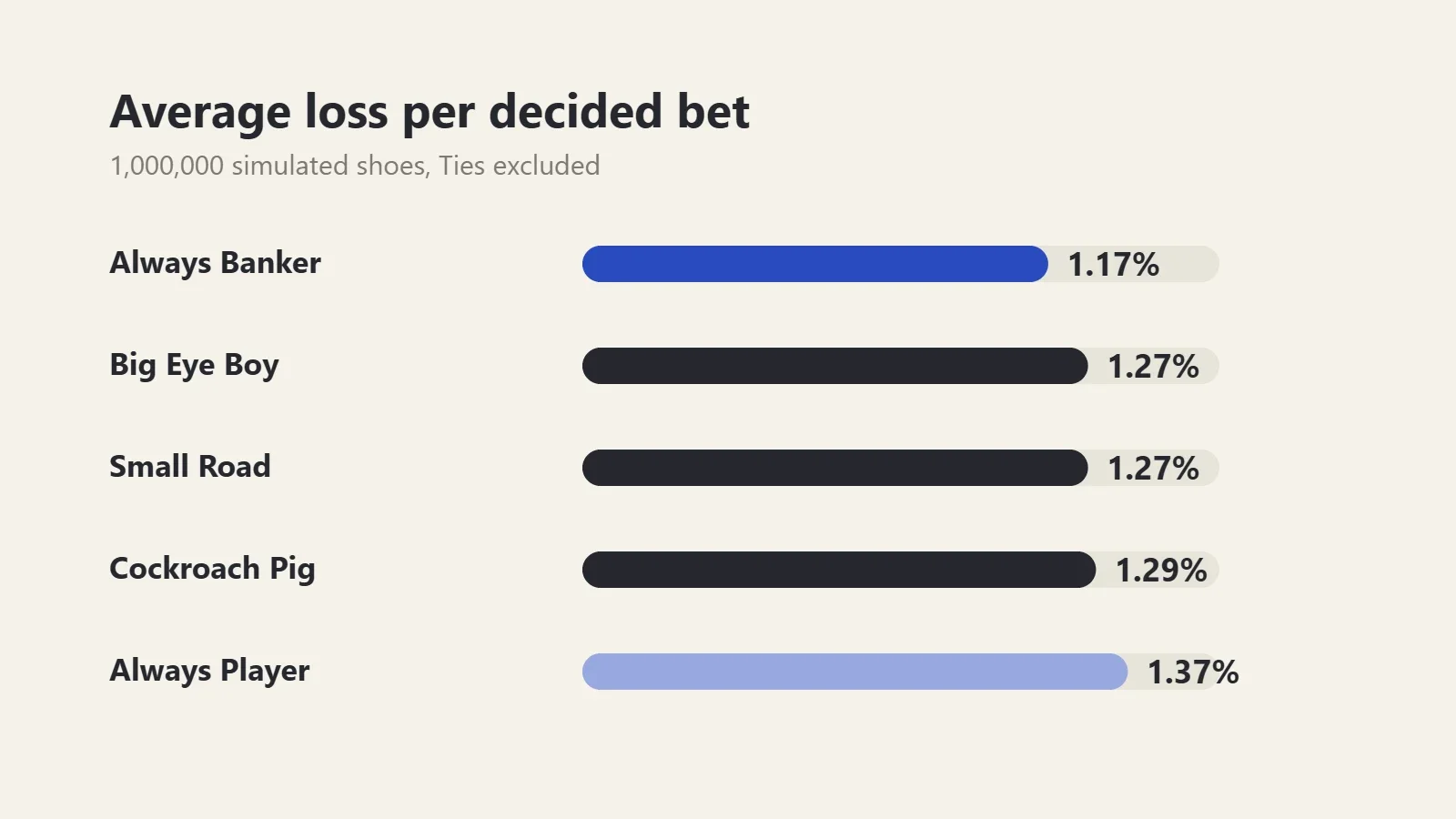
Before each hand, a derived road can tell you which color it would draw if Banker wins and which if Player wins. The two are always opposite. Many players bet the side that would draw red. We tested that over 1,000,000 8-deck shoes.
| Banker bets won | Player bets won | Average result per bet | |
|---|---|---|---|
| Baseline (always Banker / always Player) | 50.69% | 49.31% | −1.17% / −1.37% |
| Following Big Eye Boy | 50.69% | 49.31% | −1.27% |
| Following Small Road | 50.68% | 49.31% | −1.27% |
| Following Cockroach Pig | 50.68% | 49.30% | −1.29% |
The win rates on each side are identical to the baseline down to rounding. The average result of following a road lands between always Banker and always Player, because a road picks Banker about half the time and Player about half the time. You pay a little more than pure Banker, for nothing.
Following the derived roads doesn't change who wins. It only changes how often you bet Player.
This matches what we found for streaks and chops in baccarat patterns. At the start of a fresh shoe every bet has a negative expected value. Only the cards left in the shoe can change that, and only briefly. Scoreboard patterns and betting systems can't.
Look at the cards, not the colors
The derived roads are built from results. What actually moves the odds is which cards have left the shoe, which is what Baccarator tracks.
After each hand you enter the cards and tap Calculate, and Baccarator recalculates the odds and expected value for Banker, Player, Tie, pairs and side bets from the cards still in the shoe. If a bet briefly turns positive, it shows a Kelly sizing suggestion. That only appears when expected value is positive, it is a long-run average, and the next hand can still lose. Positive moments are rare and short. You can choose 6 or 8 decks and practice with virtual chips, with no real money involved.
Baccarat derived roads FAQ
What is Big Eye Boy in baccarat?
A derived road drawn from the Big Road. It compares each new result with the column one step to the left and marks red for a regular pattern and blue for an irregular one.
Do red and blue mean Banker and Player?
No. On the derived roads, red means the Big Road is repeating a shape and blue means it isn't.
Can derived roads predict baccarat results?
No. In 1 million simulated shoes, betting the side that would make a derived road red won Banker bets 50.69% of the time, the same as always betting Banker.
Baccarator is a math tool for education. No real-money gambling. 21+ only.
