There are no hot baccarat tables. In 2 million simulated 8-deck shoes, after Banker won 7 or more of the last 10 decided hands, Banker won the next one 50.68% of the time. That is exactly its usual rate with ties left out. After a Player-heavy run, Banker's rate was 50.69%. The table's recent past made no difference.
The feeling of a hot table is real, and it is easy to understand where it comes from. The math just doesn't back it up.
Do baccarat tables get hot? What 2 million shoes show
We tested three versions of the idea. A hot run in the last 10 hands, a hot first half of a shoe, and a hot shoe followed by another shoe at the same table.
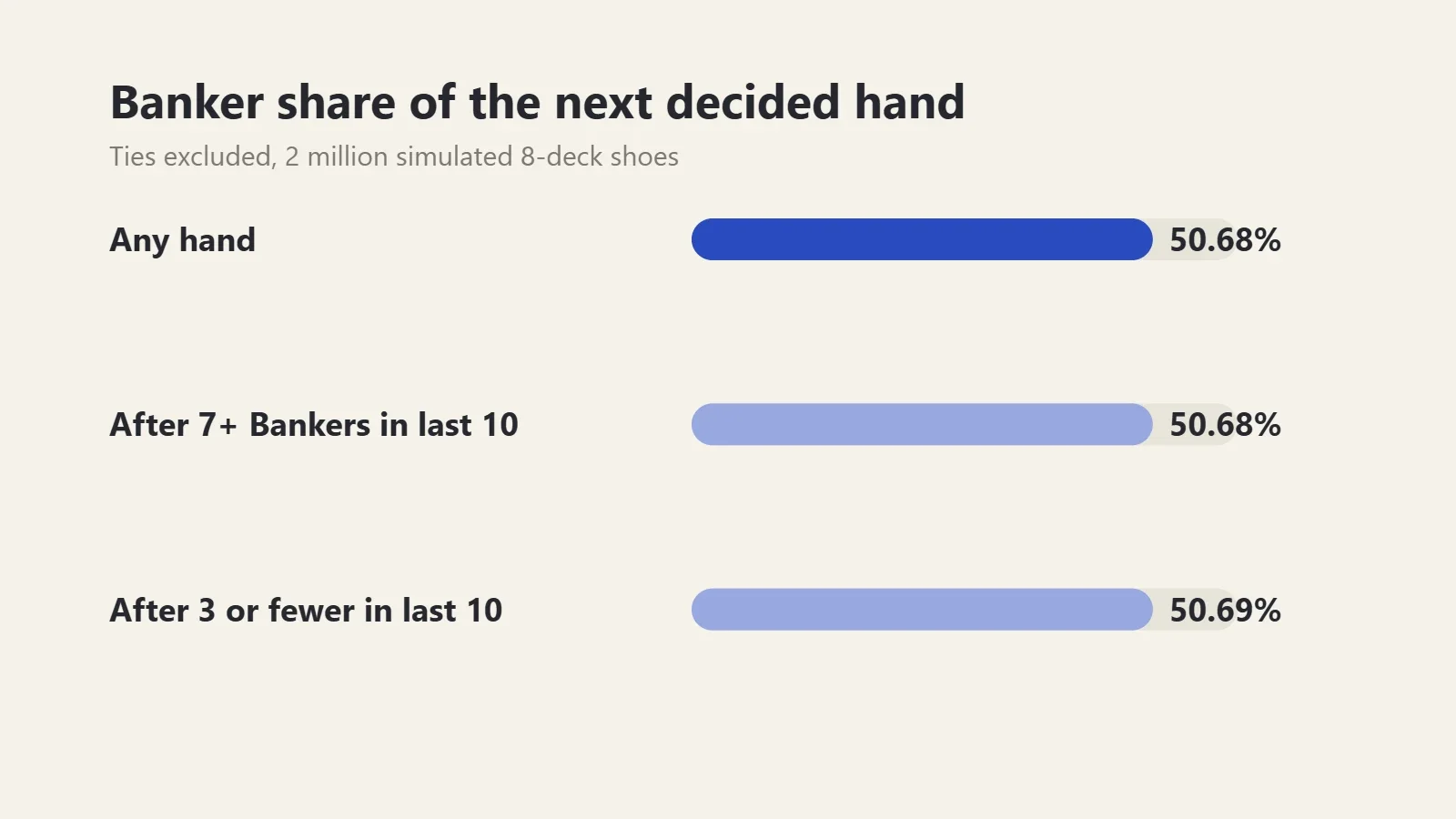
| Banker share | |
|---|---|
| Any hand | 50.68% |
| After 7 or more Bankers in the last 10 decisions | 50.68% |
| After 3 or fewer Bankers in the last 10 decisions | 50.69% |
| In a shoe that follows a Banker-heavy shoe | 54.91% |
| In a shoe that follows a Player-heavy shoe | 54.77% |
Within a shoe the halves don't carry over either. When Banker won more of the first half of a shoe, it won more of the second half 53.47% of the time. When Player won more of the first half, Banker won more of the second half 53.49% of the time. Those rates match, and both are above 50% only because Banker wins slightly more hands overall.
A hot first half of a shoe tells you nothing about the second half.
A Banker-heavy run doesn't make the next hand more likely to be Banker.
Shoe to shoe is the same story. A new shoe is a new shuffle, so a Banker-heavy shoe says nothing about the next one: 54.91% against 54.77%, within normal random variation.
A new shuffle wipes out any connection between one shoe and the next.
Gambler's fallacy and the hot hand in baccarat
Two opposite ideas drive table hopping. The gambler's fallacy says a side is "due" after it has been missing. The hot hand idea says a side that is winning will keep winning. Our data rejects both. The next hand's odds only depend on the cards still in the shoe, and the last few results barely change that mix.
Runs feel meaningful because they are common. A streak of six in one shoe is normal, as baccarat streak probability shows. When several tables are running at once, one of them will almost always be on a streak. That doesn't mean it will continue.
One table is almost always on a streak somewhere. That is randomness, not heat.
At the start of a fresh shoe every bet has a negative expected value. Only the cards left in the shoe can change that, and only briefly. Choosing a table by its recent results is a betting system, and betting systems can't. More on reading results in baccarat patterns.
Look at the cards, not the scoreboard
If you want to know whether a shoe has actually changed, the cards are the only thing that can tell you.
After each hand you enter the cards and tap Calculate, and Baccarator recalculates the odds and expected value for Banker, Player, Tie, pairs and side bets from the cards still in the shoe. If a bet briefly turns positive, it shows a Kelly sizing suggestion. That only appears when expected value is positive, it is a long-run average, and the next hand can still lose. Positive moments are rare and short. You can choose 6 or 8 decks and practice with virtual chips, with no real money involved.
Hot baccarat tables FAQ
Are there hot baccarat tables?
No. After a Banker-heavy or Player-heavy run, the next decided hand went Banker 50.68% or 50.69% of the time in our data, the same as any hand.
Should you change tables after losing in baccarat?
Changing tables doesn't change the odds. Every table has the same house edge on each bet.
What is the gambler's fallacy in baccarat?
It is the belief that a side is due after it has been missing, like expecting Player after five Bankers. Past results don't change the next hand.
Baccarator is a math tool for education. No real-money gambling. 18+ only.
